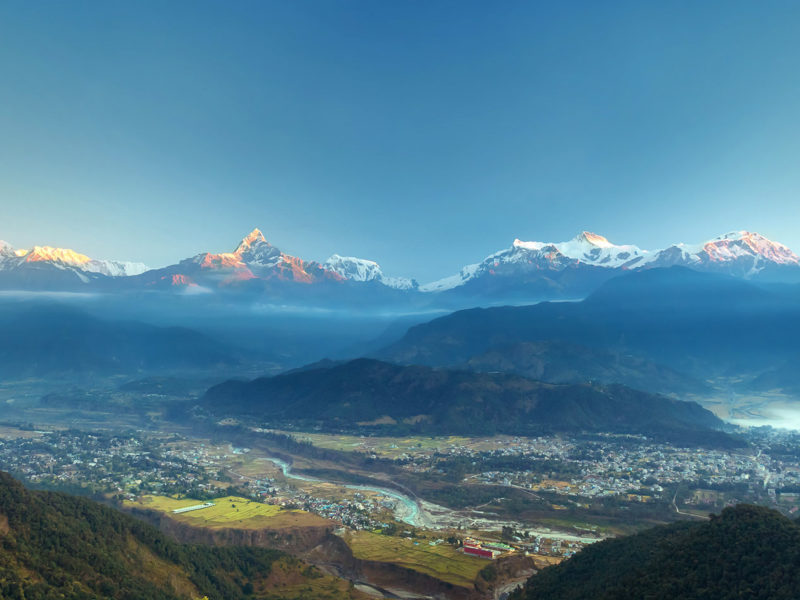
If Kathmandu is Nepal's soul, Pokhara is its breath. Set on the shores of Fewa Lake, with the snow-capped Annapurna range behind it and the sharp peak of Machapuchare mirrored in the calm water, this is the place where travellers slow down. There's none of the capital's chaos and traffic here — instead a laid-back lakeside town that also holds the title of the country's number-one adventure destination. It's that rare place that gives you both: complete relaxation by the water and pure adrenaline up high.
In this guide you'll find everything you need to plan your stop in Pokhara as a traveller from Greece: what Fewa Lake and the Lakeside district are, where to stay by budget, the classic half-day trips (Sarangkot, Peace Pagoda, Davis Falls, Gupteshwor, Begnas), which adrenaline activities await you, why it's the gateway to Annapurna, how to get there from Kathmandu — and a ready-made "Pokhara in 3 days" plan. It's part of our overall Nepal travel guide.
Fewa Lake & Lakeside
The heart of Pokhara beats around Fewa (Phewa) Lake, one of Nepal's largest lakes. A ride in one of the colourful wooden boats out to the little Tal Barahi shrine, on the tiny island at its centre, feels almost ceremonial — and the sunset, with the peaks turning pink, is the town's most famous postcard. In the morning, if the sky is clear, you'll see the whole "Fishtail" standing above the water.
Running along the shore is Lakeside (Baidam), Pokhara's tourist district: a long promenade full of cafés, lakeview restaurants, live-music bars, bookshops, trekking-gear stores and adventure offices on every corner. It's relaxed, safe and easy to walk. The northern, quiet end of Lakeside is ideal for those who want calm, the central stretch buzzes with life, while Damside (Pardi), at the southern end, is quieter and cheaper.
Pokhara is an easy town: most things are done on foot within Lakeside, while for the day trips you'll get around by taxi, motorbike or a rented scooter. Beyond the tourist front, it's worth a wander through the Old Bazaar and the Bindhyabasini temple — the religious heart of the old town — for a taste of everyday, non-touristy Pokhara. The climate is milder and more humid than Kathmandu's, with lush greenery all around, and that's one more reason so many travellers end up staying longer than they planned.
Where to stay by budget
- Backpacker (€10–20): hostels and simple guesthouses in the Lakeside back-streets, clean and social, many with a rooftop and a view.
- Mid-range (€25–60): boutique hotels with a garden, a lake-facing balcony and breakfast — the best value in town.
- Premium (€80+): resorts beside or above the lake, with a pool, spa and panoramic Annapurna views; this is where the top stays chosen by Elysian Himalaya sit.
The classic half-day trips
Pokhara's trump card is that almost every sight lies 15–60 minutes from Lakeside. You can comfortably see two or three in a single day. Start with sunrise at Sarangkot (1,600 m): you drive up by jeep before dawn and watch the sun successively "ignite" the peaks of Dhaulagiri (8,167 m), Annapurna and Machapuchare (6,993 m) — the trip's defining image for many. The same hill is also the launch point for paragliding and the zipline.
| Sight | Distance / access | Time needed | Indicative cost |
|---|---|---|---|
| Sarangkot (sunrise) | ~30 min by jeep/taxi | 2–3 hrs (pre-dawn) | ~€5–10 taxi + small entry |
| World Peace Pagoda | Boat on Fewa + 30–45′ climb, or taxi | 2–3 hrs | Free entry (boat ~€3–5) |
| Davis Falls & Gupteshwor | ~15 min south (Chhorepatan) | 1–2 hrs | ~€0.50–1 entry each |
| Begnas Lake | ~40–60 min east | Half day | ~€3–5 taxi/bus |
| International Mountain Museum | ~20 min south | 1–2 hrs | ~€4–5 entry |
The World Peace Pagoda (Shanti Stupa) is a white Buddhist stupa on a hill across from Lakeside, with panoramic views over the lake, the town and the whole Annapurna range — the calmest way to "read" Pokhara's geography. Davis Falls is a waterfall that dramatically disappears into the earth, and directly opposite lies the underground Gupteshwor cave, with a sacred Shiva shrine deep inside it. A little further out, Begnas Lake offers Pokhara without the tourists: green, quiet and dotted with boats, ideal for a relaxed half day. Finally, the International Mountain Museum is worth it if you're interested in the history of Himalayan mountaineering.
Adventure up high and on the water
Pokhara didn't earn its title as the capital of adventure by accident. The combination of a high mountain, steady thermals and a lake at the base creates a natural adrenaline park, where activities can be done one after another within the same day.
- Paragliding (~€65–90): perhaps the town's ultimate experience. You fly tandem with an experienced pilot, with no experience of your own, launch from Sarangkot and "hang" calmly in the air like a bird, with the Himalayas in view, before landing beside Fewa. A flight lasts ~30 minutes.
- Zipline (~€55–75): the exact opposite — pure speed. The Sarangkot ZipFlyer is 1.8 km long, with a 600 m vertical drop and speeds up to 120 km/h, among the steepest and fastest in the world. All the details are in our dedicated guide to the Pokhara zipline.
- Ultralight flights: small two-seat aircraft that take off from Pokhara's airport and bring you as close to the peaks as permitted — from ~€90 for ~15 minutes, with longer flights approaching the 8,000ers.
- Rafting & kayaking: Pokhara is a base for some of the country's most beautiful rivers, like the warm, gentle Seti (~35 km away) and the spectacular Kali Gandaki inside its gorge. See our full guide to rafting and kayaking in Nepal.
- Bungee jumping: for the boldest, a free fall from a purpose-built tower overlooking the lake — the town's rawest hit of adrenaline, over in a few seconds.
The classic combo is sunrise at Sarangkot, tandem paragliding early in the morning and the zipline straight after — everything launches from the same mountain. Combo packages (paragliding + zipline) work out cheaper, around €110–150.
The gateway to Annapurna trekking
Beyond the leisure, Pokhara is the starting point for almost every Annapurna trekking route. From here, a short jeep ride drops you at the trailheads (Nayapul, Kimche, Kande) and the trail begins. The three classic options:
- Poon Hill (4–5 days, 3,210 m): the perfect introduction to the Himalayas — short, gentle altitude, culminating in sunrise over Dhaulagiri and Annapurna. Suitable even for families.
- Annapurna Base Camp (10–12 days, 4,130 m): the most balanced "big" trek, ending in the legendary amphitheatre of the Annapurna Sanctuary.
- Annapurna Circuit (12–18 days, Thorong La 5,416 m): the "ultimate" trek all the way around the massif.
You don't even need a multi-day trek to set foot on a Himalayan trail. Nearby short options like Australian Camp, the village of Dhampus or the quiet Mardi Himal ridge start just outside Pokhara and deliver top-tier views with minimal time commitment — ideal if you only have two or three free days.
All of the above, along with permits (ACAP), seasons and sample itineraries, are covered in our full guide to trekking Annapurna. This is why most travellers spend 1–2 days in Pokhara before the mountain (for supplies and rest) and just as many after — Fewa Lake is the ideal "cushion" for tired legs.
How to get there from Kathmandu
Pokhara is ~200 km from the capital, along the Prithvi Highway. You have three ways to reach it — see what suits you:
| Mode | Duration | Indicative cost | Notes |
|---|---|---|---|
| Flight | ~25 minutes | ~€90–130 | Spectacular Himalayan views from the window (sit on the right) |
| Tourist bus | ~6–8 hours | ~€8–15 | Cheap & comfortable, with meal stops |
| Private vehicle | ~6–7 hours | ~€80–120 | Flexible, ideal for a rafting stop on the Trishuli |
In practice: if you're short on days, the 25-minute flight saves you almost a whole day and gives you views of the peaks. If you want to "see" the route and combine a rafting stop on the Trishuli, a private vehicle is the best choice. Remember that all flights and buses leave from the capital, Kathmandu — and that there's no direct flight from Athens to Nepal (you fly with one stop, ~12–18 hours, ~€430–800 return).
Pokhara in 3 days
If you want to make the most of a three-day stop without rushing, this plan balances adventure and relaxation:
| Day | Programme |
|---|---|
| 1 | Arrival, a relaxed walk in Lakeside, a boat ride on Fewa Lake out to the Tal Barahi shrine, and sunset with the peaks in view. |
| 2 | Sunrise at Sarangkot (05:30), tandem paragliding in the morning and the zipline straight after; lunch in Lakeside and an afternoon at the Peace Pagoda. |
| 3 | Davis Falls & Gupteshwor cave, a trip to quiet Begnas Lake or a half-day raft on the Seti; a farewell evening in Lakeside. |
Only have 2 days? Keep day 1 and day 2. Have more? Add a short Poon Hill trek or set off from here for Annapurna Base Camp. The best window for all of this is autumn (Oct–Nov) and spring (Mar–Apr) — see in detail the best time to travel to Nepal.
Pokhara with Dimitris — Elysian Himalaya's premium base
Pokhara is the premium base of Elysian Himalaya — our top tier for tailor-made Himalayan journeys, with a Greek point of contact and a team on the ground. Same team, same phone, same office, simply the premium version: hand-picked stays beside or above the lake, private transfers, sunrise at Sarangkot without the crowds, and activities (paragliding, zipline, rafting) booked in advance and woven into one carefully curated programme. Whether you travel independently or with full support — or with the company of a Greek group trip — nepal.gr is your Greek starting point.
Pokhara is the place where Nepal lets you catch your breath and, at the same time, hands you the most intense dose of adrenaline of your whole journey. Lake and mountain, calm and speed, relaxation and adventure — all within a few minutes of each other. It's no accident that for most travellers it becomes their favourite part of Nepal.
Gallery
Frequently asked questions
- Two to three days are enough to see the highlights: sunrise at Sarangkot, a boat ride on Fewa Lake, the Peace Pagoda, Davis Falls and one adrenaline activity (paragliding or zipline). If you use it as a base for Annapurna trekking, add 1–2 relaxing days before and after the mountain.
- Two main options: a ~25-minute flight (~€90–130, with Himalayan views from the window) or the road along the Prithvi Highway, ~200 km. The tourist bus takes ~6–8 hours and costs ~€8–15, while a private vehicle is ~€80–120 with the freedom to stop (e.g. rafting on the Trishuli).
- Absolutely — Pokhara is one of the top paragliding destinations in the world. You fly tandem with an experienced pilot (no experience needed), launch from Sarangkot and land beside Fewa Lake. A ~30-minute flight costs around €65–90 and the view towards Annapurna and Machapuchare is unforgettable.
- October–November and March–April: clear skies, perfect visibility of the peaks and ideal conditions for flights and sunrise at Sarangkot. Avoid the monsoon (June–September), when clouds often hide the mountains.
- It is the prime gateway to the Annapurna treks. Poon Hill, Annapurna Base Camp and the Annapurna Circuit all start from here — a short jeep ride drops you at the trailheads. Many spend 1–2 days in Pokhara before and after the mountain to rest by the lake.
- Plenty: boating and sunset on Fewa, sunrise at Sarangkot, paragliding or the zipline, a visit to the Peace Pagoda, Davis Falls and Gupteshwor cave, a trip to quiet Begnas Lake, or a laid-back day of cafés and shopping in Lakeside.
Keep reading
Related articles
 Destinations
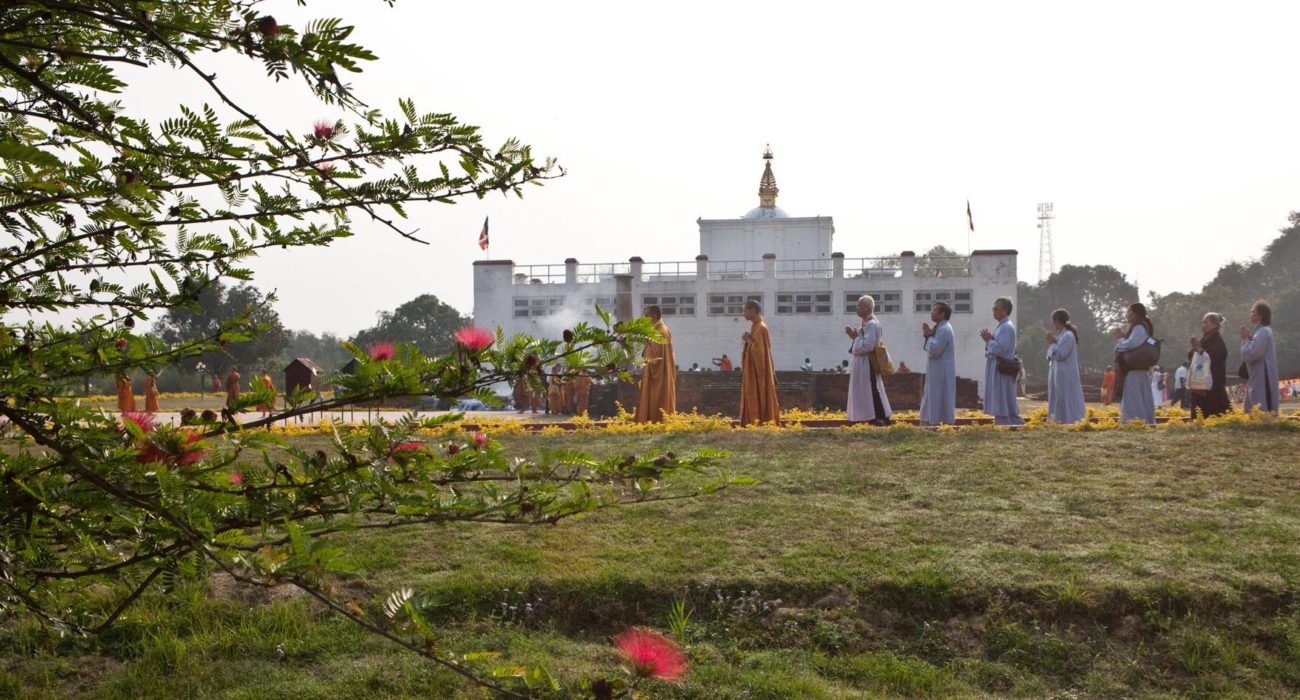
Lumbini, the Birthplace of Buddha
Discover the birthplace of Buddha — the Maya Devi temple, the Ashoka pillar, the international monasteries and everything to see at this sacred site in southern Nepal.
 Destinations
Chitwan National Park
Safaris, tigers and rhinos in Nepal's first national park — a UNESCO World Heritage site in the jungle of the Terai.
 Destinations
Kathmandu, the Capital of Nepal
Kathmandu is a living museum — 7 UNESCO sites, ancient Newari architecture, Hindu temples, Buddhist stupas and the living goddess Kumari.