

Poon Hill Trek (Ghorepani): The Perfect First Himalayan Trek
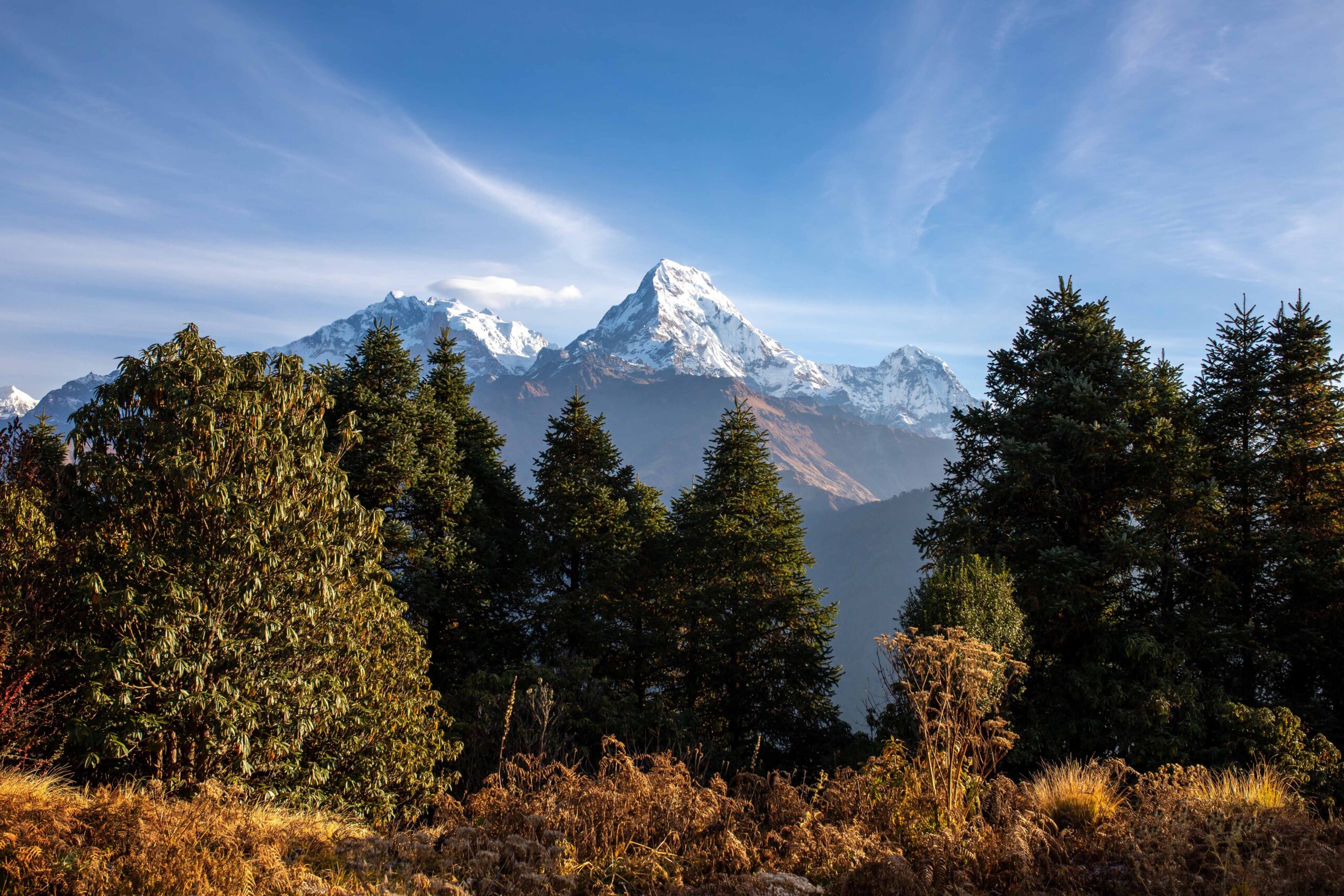
If you dream of the Himalayas but have no mountain experience, no two spare weeks, and no appetite for 5,000-metre altitudes, the Poon Hill trek (also known as Ghorepani Poon Hill) is made for you. It's Nepal's most popular short route and, rightly, the trek we recommend again and again to anyone taking their first steps in the Himalayas: 4-5 days, a high point of just 3,210 metres, and a sunrise you'll remember for a lifetime, with the giants of Annapurna and Dhaulagiri catching fire in the first light.
This guide has everything you need to plan it from Greece: a day-by-day itinerary, what drives the cost, the best season, the permits, plus the two top extensions — Mardi Himal and Annapurna Base Camp — for when you want something more.
Why Poon Hill is the ideal first trek
Nepal has dozens of routes, but few combine such a big reward with so little difficulty. Poon Hill:
- Stays low. You top out at 3,210m, well below the altitude where sickness becomes a real concern. You don't need weeks of acclimatisation.
- Is short. In 4-5 days you see eight peaks above 6,000m without having to take a two-week holiday from work.
- Has comfortable teahouses every few hours. You sleep in warm lodges with a bed, hot food and (usually) a hot shower — no tent, no carrying food.
- Is family-friendly. Children from around 8, parents and older travellers complete it comfortably at the right pace.
Think of it as the perfect introduction to trekking in Nepal: if you love it, the big treks — Annapurna Base Camp, Everest Base Camp — suddenly become realistic.
The essentials at a glance
| Detail | Info |
|---|---|
| Duration | 4-5 days (short version 3, with extensions 7-12) |
| Difficulty | Easy to moderate — beginner-friendly |
| Max altitude | Poon Hill: 3,210m |
| Start point | Pokhara (~1.5-2h transfer to the trailhead) |
| Best season | Oct-Nov & Mar-Apr |
| Daily walking | 4-6 hours |
| Permit | ACAP (~€22) + licensed guide |
Where it is and how to get there
Poon Hill sits in the Annapurna region of the western-central Himalayas, with Pokhara — Nepal's second city and undisputed trekking hub — as the launch base. From Pokhara, a taxi or jeep takes you to the trailhead in about 1.5-2 hours.
The trek traditionally started from the village of Nayapul (~1,070m). In recent years, though, a dirt road has pushed higher, so many people now start at Hile or Tikhedhunga, skipping a stretch of monotonous walking. Your guide will suggest the best starting point depending on the season and road conditions.
Detailed itinerary (classic 4-day loop)
Below is the most popular version, a loop through the two most beautiful Gurung villages in the area, Ghorepani and Ghandruk.
| Day | Route | Altitude | Hours |
|---|---|---|---|
| 1 | Pokhara → Nayapul/Hile → Ulleri → Ghorepani | ~2,860m | 5-6 |
| 2 | Sunrise at Poon Hill → Ghorepani → Tadapani | ~2,630m | 5-6 |
| 3 | Tadapani → Ghandruk | ~1,940m | 3-4 |
| 4 | Ghandruk → Nayapul → Pokhara | ~820m (finish) | 3-4 + transfer |
Day 1: The climb to Ghorepani
After the transfer from Pokhara, the trail climbs through rice terraces and villages. The day's big test is the famous Ulleri stone stairs — around 3,000 steps that rise steeply. Take your time, drink water and enjoy the view; at the top, Ghorepani awaits, a picturesque village at 2,860m and the ideal overnight stop.
Day 2: The sunrise that's worth the whole trip
You wake in the dark, around 4:30, and climb by headtorch for roughly 45 minutes to the top of Poon Hill (3,210m). There, as the sun rises, you see one of the most spectacular panoramas in the Himalayas: Dhaulagiri (8,167m), Annapurna South (7,219m), Machapuchare / Fishtail (6,993m), Nilgiri and Hiunchuli shifting from pink to gold. After sunrise you drop back to Ghorepani for breakfast and continue through enchanting rhododendron forest towards Tadapani.
Day 3: Through the forest to Ghandruk
A more relaxed day, descending through dense forest where birds are common and, with a little luck, you'll spot langur monkeys. You end at Ghandruk (~1,940m), perhaps the most beautiful traditional Gurung village in Nepal, with stone houses and views straight onto Annapurna South and Fishtail.
Day 4: Back to Pokhara
A final descent to Nayapul, from where the jeep returns you to Pokhara for a hot shower and a drink by Phewa Lake. In the 5-day version, an extra night is usually added at Ghorepani or Tadapani for a gentler pace or a second look at the sunrise.
Difficulty and who it's for
Poon Hill is easy to moderate. You need no technical skills or mountaineering gear — just basic fitness and good boots. The only real challenges are the Ulleri stairs and the early sunrise start. Because you never go above 3,210m, the risk of altitude sickness is minimal, which makes it far safer for beginners than Everest or Annapurna Base Camp. It's ideal for families with children (from around 8), for couples, and for anyone who wants to test whether high-mountain trekking suits them before committing to something bigger.
Best season
Poon Hill runs year-round, but two windows stand out. See our full guide to the best time to visit Nepal.
| Season | What to expect |
|---|---|
| Oct-Nov | The best window: clear skies, stable weather, superb visibility of the peaks. |
| Mar-Apr | Spring: the rhododendron forests around Ghorepani bloom red and pink — magical. |
| Dec-Feb | Winter: very clear views but cold, with possible snow/ice on the high stairs. |
| Jun-Sep | Monsoon: rain, cloud, leeches and often hidden peaks — not recommended. |
What drives the cost
Poon Hill is one of the most affordable treks in the Himalayas, but it does not have a single fixed price. What shapes it is the season (peak October-November is not the same as February), the size of the group, the length (4 days, 5 days, or with a Mardi Himal / ABC extension), whether you want a guide and a porter, the comfort level of the lodges, and how you travel to and from Pokhara.
The only items known in advance are the official fees: the ACAP permit costs NPR 3,000 (~€22) per person. In the teahouses, the institution of the mountains, dal bhat (rice, lentils, vegetables), costs €2-5 and often comes with free refills — fuel for those stairs.
Tell us how many days you have, whether you want Poon Hill on its own or with the Mardi Himal extension, and when you are thinking of going. Ask us for a quote.
Permits and guide
For Poon Hill you need the ACAP permit (Annapurna Conservation Area Permit), around NPR 3,000 (~€22), easily issued in Pokhara or Kathmandu. The TIMS card is no longer checked in the Annapurna region. Important: since April 2023, Nepal's Tourism Board requires a licensed guide for independent trekkers in many areas, Annapurna included — so in practice you'll need a guide. The rules change from time to time, so confirm them shortly before you leave. Beyond the formal requirement, a good guide adds enormous value: they know the trails, the teahouses, the weather and the local culture.
Accommodation and food
Throughout the route you sleep in teahouses — simple but warm family-run lodges with basic twin rooms, a shared dining hall with a wood stove, and a menu of Nepali and international dishes. You need no tent, cooking gear or food; it's all provided on the spot. A good sleeping bag (comfort ~ -5°C) helps on cold nights, though most lodges provide blankets. A hot shower and phone charging often cost a few euros extra.
What to pack
- Waterproof hiking boots you've already broken in (not brand new!)
- A layering system: breathable base layer, fleece, waterproof-windproof jacket
- A warm jacket and hat/gloves for the freezing Poon Hill sunrise
- Headtorch (essential for the pre-dawn summit), sunscreen, sunglasses
- Water bottle with purification tablets or a filter
- Trekking poles — they save your knees on the descent
- Some rupees in cash (there are no ATMs in the mountains)
In Kathmandu's Thamel and in Pokhara you can cheaply rent or buy anything you're missing, from jackets to sleeping bags.
Extensions: Mardi Himal and Annapurna Base Camp
Poon Hill connects naturally to two excellent, longer routes if you have more days:
- Mardi Himal (+3-4 days): a quieter, spectacular ridge-line route with Machapuchare towering up close. An ideal combination for anyone wanting something less crowded.
- Annapurna Base Camp (+4-6 days): from Ghorepani/Tadapani the trail climbs to the legendary "amphitheatre" at 4,130m, ringed by peaks. See our full guide to Annapurna and the Annapurna Base Camp.
Many people start with Poon Hill and, once they've found their mountain rhythm, continue to Base Camp on the same trip — perfect for ten days in the Himalayas.
From Greece: the practicalities
There's no direct Athens-Kathmandu flight; you'll make one stop (Istanbul, Doha, Abu Dhabi or Dubai), for a total of ~12-18 hours and a round-trip fare of roughly €430-800. From Kathmandu, a short flight or a bus/jeep ride brings you to Pokhara, the trek's starting point. Overall, a 10-12 day trip with Poon Hill at its core fits comfortably into a normal holiday. For everything else (visa, currency, vaccinations, insurance) see our general Nepal travel guide.
Poon Hill with a Greek team
The best thing about Nepal is that you don't have to do it alone. We organise departures with Dimitris and experienced local guides, so you never have to deal with permits, transfers or lodging — you just show up and walk. And if you want something more private and comfortable — hand-picked stays, a personal programme, your own pace — our premium sister brand, Elysian Himalaya, designs Poon Hill (and its extensions) as a polished private journey from the same Greek team in Nepal.
Whether it's your first step in the Himalayas or a beautiful four-day escape, Poon Hill offers a rare ratio of "minimum difficulty, maximum reward". Few treks in the world give you so much in so little time.
Gallery
Frequently asked questions
- Easy to moderate — it's widely considered the most beginner-friendly trek in the Himalayas. You walk 4-6 hours a day with one demanding climb (the Ulleri stone stairs). The high point is only 3,210m, so altitude-sickness risk is very low.
- The classic loop is 4-5 trekking days from and back to Pokhara. There's a short 3-day version, and with a Mardi Himal or Annapurna Base Camp extension it grows to 7-12 days.
- Yes. It's one of the few Himalayan treks that children from around 8 and people with no mountain experience can do comfortably, thanks to the low altitude, daily teahouses and short daily distances.
- There is no single figure. The cost depends on the season, the size of the group, the length of the trek, whether you want a guide and a porter, and the comfort level of the lodges. The only fixed item is the ACAP permit (~€22). Tell us what you have in mind and we will send you a quote through our contact page.
- October-November for the clearest skies and March-April for the blooming rhododendrons in the Ghorepani forest. Winter is also doable but cold, with possible snow on the stairs.
- You definitely need the ACAP permit (~€22). Since 2023 Nepal's Tourism Board requires a licensed guide for independent trekkers in the Annapurna region; the TIMS card is no longer checked there. Confirm the current rules before you leave.
Keep reading
Related articles
 Activities
Trekking in Nepal: The Complete Hiking Guide
The definitive guide to trekking in Nepal: teahouse trekking, the main regions, a comparison of the top treks, permits, seasons and how to choose your route.
 Trekking
Annapurna: The Complete Trekking Guide to Nepal's Most Popular Region
The Annapurna massif, the top routes (ABC, Circuit, Poon Hill, Mardi Himal, Tilicho), the ACAP permit, seasons, sample itineraries and how to choose.
TrekkingAnnapurna Base Camp Trek (ABC): The Complete Guide
The 'amphitheatre of the gods' at 4,130m: a day-by-day itinerary, difficulty, ACAP permits, seasons and how to combine it with Poon Hill.