

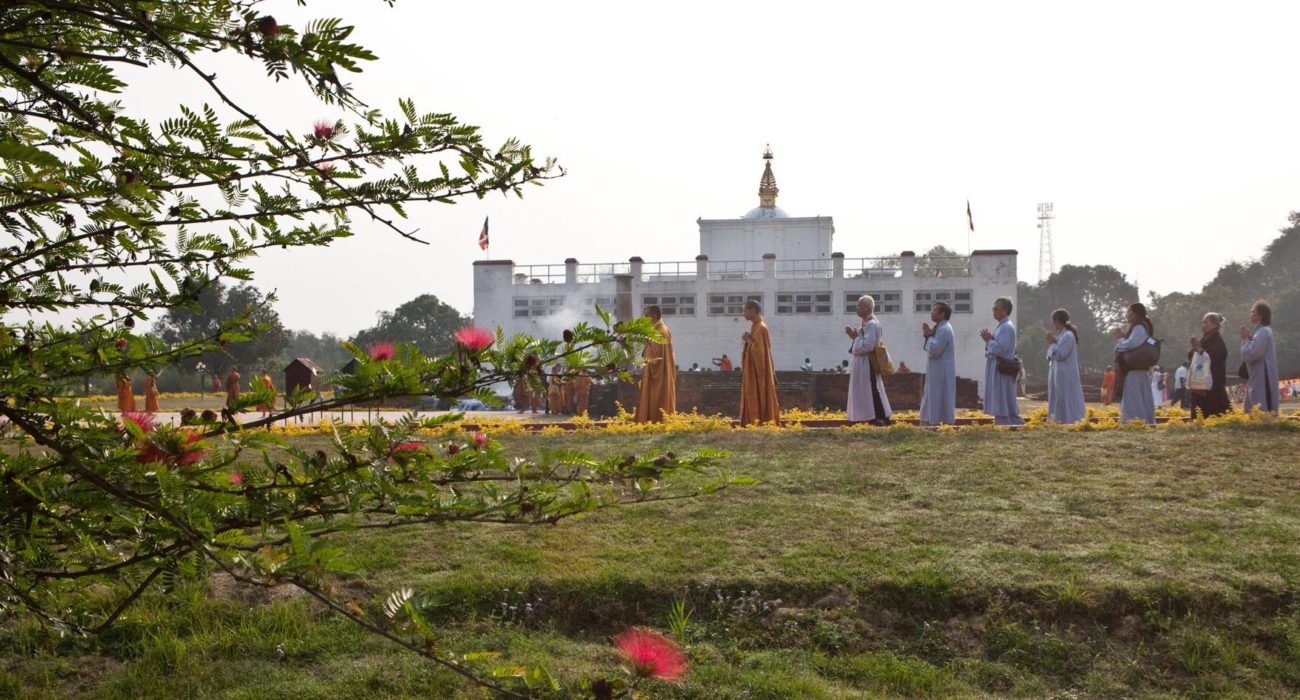
Some places you don't just visit — you feel them. Lumbini, on Nepal's southern Terai plain, a few kilometres from the Indian border, is one of them. Here, around 563 BCE, Siddhartha Gautama was born — the man who would become the Buddha. This is no legend: an ancient stone pillar, raised here more than 2,200 years ago, confirms it in its own carved text. That is why Lumbini is a UNESCO World Heritage Site (since 1997) and one of the four holiest pilgrimage sites in Buddhism — alongside Bodh Gaya (enlightenment), Sarnath (first sermon) and Kushinagar (death).
For a traveller coming from the noise of Kathmandu or the action of Pokhara, Lumbini is a breath of stillness. A vast garden with monasteries from across the Buddhist world, monks walking slowly, prayer flags fluttering, and a sense of peace you rarely find. This guide gives you everything you need: what to see, how to get there, where to stay and a ready-made plan for your day.
The Sacred Garden: the Maya Devi temple
At the heart of Lumbini is the Sacred Garden and, within it, the Maya Devi temple — the exact spot where the Buddha was born. It takes its name from Queen Maya Devi, Siddhartha's mother, who by tradition gave birth standing, holding the branch of a tree, as she travelled toward her family home.
Inside the plain white temple lies the protected marker stone — an ancient stone pinpointing the precise place of birth — along with a worn relief depicting the scene. Around them, the brick foundations of ancient monuments are exposed, layers of history reaching back to the era of Emperor Ashoka. The space breathes silence: visitors move slowly, respectfully. Photography inside is forbidden — put the camera away and simply stand.
The Ashoka pillar
A few metres from the temple stands the most historically important object on the whole site: the Ashoka pillar. The great Buddhist emperor Ashoka visited Lumbini as a pilgrim in 249 BCE and raised this tall stone column with an inscription in Brahmi script. The text states, in essence, that "here the Buddha was born" and that the emperor significantly reduced the village's taxes in its honour. It is, in effect, humanity's oldest written "birth certificate" for so significant a person.
The pillar was forgotten in the jungle for centuries and rediscovered in 1896, giving archaeologists the definitive proof that this — and no other place — is the true Lumbini. Today it is protected by a railing and adorned with colourful prayer flags.
The sacred Puskarni pond & the Bodhi tree
Right in front of the temple lies the Puskarni, the sacred rectangular pond with stone steps. Tradition holds that Queen Maya Devi bathed here before giving birth, and that this was the site of the newborn Buddha's first bath. Beside it rises a large, old Bodhi tree (sacred fig, Ficus religiosa), draped with thousands of prayer flags. In its shade, monks and pilgrims sit and meditate — one of the most beautiful, peaceful images in all of Nepal. Near the garden entrance burns the Eternal Peace Flame, lit since 1986.
The Monastic Zone & the international monasteries
What makes Lumbini unique in the world is the Monastic Zone. In 1978 the celebrated Japanese architect Kenzo Tange designed an ambitious master plan: a strip about 3 kilometres long, with a central canal and walkway linking the Sacred Garden in the south with the World Peace Pagoda in the north. On both sides of the canal, countries from across the Buddhist world each built their own national monastery, in the authentic architectural tradition of their homeland.
The area is divided into two zones: the East Monastic Zone, with monasteries of the Theravada tradition, and the West Monastic Zone, with Mahayana and Vajrayana monasteries. The result is an open-air museum of Buddhist architecture — a walk from Thailand to Germany and from China to Myanmar, all in a single day.
| Country | Monastery / Temple | What you'll see |
|---|---|---|
| Myanmar | Lokamani Pula Pagoda | A striking golden pagoda in Burmese style — one of the most photographed spots |
| Thailand | Royal Thai Monastery / Wat Thai | A gleaming white-marble temple, classic Thai elegance |
| China | Zhong Hua Chinese Buddhist Monastery | Courtyards, pagodas and gardens in imperial Chinese style |
| Germany | Great Lotus Stupa (German Tara) | A Tibetan-style stupa with superb Vajrayana murals |
| South Korea | Dae Sung Suk Ga Sa | A large complex that also welcomes visitors to stay |
| Vietnam | Viet Nam Phat Quoc Tu | A serene temple with lotus ponds |
| Nepal / Tibet | Various (Theravada & Mahayana) | Local monasteries, gompas and stupas of the region |
Distances within the Monastic Zone are long. The smartest ways to explore it: rent a bicycle (~1€–2€ a day), take an e-rickshaw, or the boat/pontoon that runs along the central canal. Walking end to end is possible, but exceeds 5–6 kilometres in the heat of the plain.
World Peace Pagoda
At the northern end of the Monastic Zone rises the pure-white World Peace Pagoda (Shanti Stupa). It was built by the Japanese Buddhist organisation Nipponzan-Myohoji and is one of many "peace stupas" the same order has erected around the world. Roughly 41 metres tall, with a golden Buddha facing south, it offers the calmest, most open view of the whole site — ideal at sunset.
Vipassana & meditation (practical)
Lumbini isn't only to be seen — it's also to be experienced inwardly. The Monastic Zone hosts the Panditarama Lumbini International Vipassana Meditation Center, in the tradition of Mahasi Sayadaw. Courses are usually 10 days, silent, with early rising, alternating sitting and walking meditation, and simple, plain meals.
- Cost: by donation — there is no set price; you offer what you can at the end.
- Registration: required in advance, by contacting the centre; places are limited.
- Rules: full silence, no phones, modest dress, adherence to the daily schedule.
- A gentler option: several monasteries welcome visitors for a short stay and morning meditation, without the commitment of a 10-day course.
Hours, tickets & practicalities
The wider garden and the Monastic Zone are free to enter. A ticket is required only for the Maya Devi temple. The prices below are indicative — confirm them on site, as they change.
- Maya Devi temple: ~500 NPR (~3.5€) for foreign visitors.
- Sacred Garden hours: roughly 06:00–18:00 (slight seasonal variation).
- Photography: allowed in the garden and monasteries, not inside the Maya Devi temple.
- Dress: modest (covered shoulders & knees), shoes off outside temples — see our guide to customs & etiquette in Nepal.
- Best season: Oct–Mar; in summer the Terai exceeds 40°C.
How to get to Lumbini
Lumbini lies far from the two big tourist hubs, but combines beautifully with a route that already passes through the south — for example, after Chitwan National Park. The nearest airport is Gautam Buddha International Airport at Bhairahawa, ~22 km from the sacred garden.
| From | Mode | Duration | Indicative cost |
|---|---|---|---|
| Kathmandu | Flight → Bhairahawa + taxi | ~40 min + 30 min | ~90€–120€ (flight) |
| Kathmandu | Bus / car | ~8–9 hours | ~9€–15€ (tourist bus) |
| Pokhara | Bus / car | ~5–6 hours | ~8€–14€ |
| Chitwan (Sauraha) | Bus / car | ~4–5 hours | ~7€–12€ |
| Bhairahawa | Local taxi / rickshaw | ~30 min | ~3€–6€ |
For planning your transfers and routes, see our detailed guide to the essentials of travelling in Nepal.
Where to stay
Accommodation falls into three zones. In the small town of Lumbini (Lumbini Bazaar), next to the entrance, you'll find guesthouses and small hotels. In Bhairahawa/Siddharthanagar there are more options and the airport. And the most distinctive experience: several monasteries in the Monastic Zone (e.g. the Korean or the Myanmar one) welcome visitors for a short, simple stay.
- Budget: guesthouse ~8€–15€ a night.
- Mid-range: hotel ~20€–45€ (e.g. the Buddha Maya Garden type, Hotel Nirvana).
- Monastery: a symbolic fee or donation — a quiet, authentic experience (early to bed, early to rise).
Suggested 1-day plan
If you have one day, this plan covers the highlights without rushing:
| Time | Programme |
|---|---|
| Morning | Sacred Garden: Maya Devi temple, Ashoka pillar, Puskarni pond & Bodhi tree. Start early, in the cool. |
| Midday | Rent a bicycle or rickshaw. West Monastic Zone: Chinese, German (Great Lotus Stupa), Korean. Light lunch. |
| Afternoon | East Zone: golden Myanmar pagoda, white Royal Thai. Finish at the World Peace Pagoda. |
| Sunset | Stillness at the World Peace Pagoda or under the Bodhi tree. A few minutes of meditation before you leave. |
Have two days? Add a morning meditation at a monastery and a more relaxed second walk through the monasteries you missed. For organised-route ideas, see also our group trip to Nepal.
Lumbini "with Dimitris"
Lumbini is not a destination for selfies and hurried ticks on a list. It's a place that reveals itself when you slow down — when someone explains what Ashoka's inscription says, why the flags flutter, what the silence under the Bodhi tree means. At nepal.gr we want you to be able to organise it yourself, which is why this guide is thorough and free.
But if you'd like Lumbini woven into a trip tailored to you — combined with Pokhara and Chitwan, with private transport, hand-picked stays and a local guide who opens the monastery doors with respect — that is where Elysian Himalaya comes in, our premium team (same team, premium tier). Whether you arrive with a backpack or with full support, at the birthplace of the Buddha you always leave a little calmer than you came.
Gallery
Frequently asked questions
- Two ways. By air: a flight from Kathmandu to Gautam Buddha (Bhairahawa) airport takes ~40 minutes (~90€–120€), then a ~30-minute taxi to Lumbini. By road: ~8–9 hours from Kathmandu, ~5–6 hours from Pokhara, ~4–5 hours from Chitwan. Most travellers fit it into a Pokhara or Chitwan → Lumbini route.
- For the essentials — Maya Devi temple, the Ashoka pillar, the sacred pond and 4–5 monasteries — one full day is enough. To really feel the atmosphere, take in the Monastic Zone at its most peaceful and perhaps a sunrise or sunset, stay one night (2 days).
- The wider sacred garden and the Monastic Zone are free to enter. For the Maya Devi temple there is an indicative ticket of ~500 NPR (~3.5€) for foreign visitors. Small extras: bicycle rental ~1€–2€/day, or an e-rickshaw / boat to cover the large site.
- Yes, if you treat it as a calm, open day. It isn't an adventure park, but the huge garden with bicycles, boats on the canal and the striking, colourful monasteries from around the world keep children engaged. Distances are long, so a rickshaw or bicycles help a lot.
- Yes. The Monastic Zone hosts a Vipassana centre (Panditarama Lumbini) offering silent courses, classically 10 days, run on a donation basis. Advance registration is required. Several monasteries also welcome visitors for a short stay and morning meditation.
- October to March, when the Terai plain has a mild climate. Summer and the monsoon bring humidity and heat above 40°C. If you coincide with Buddha Jayanti (May full moon), you'll see Lumbini at its most festive and pilgrim-filled.
Keep reading
Related articles
 Destinations
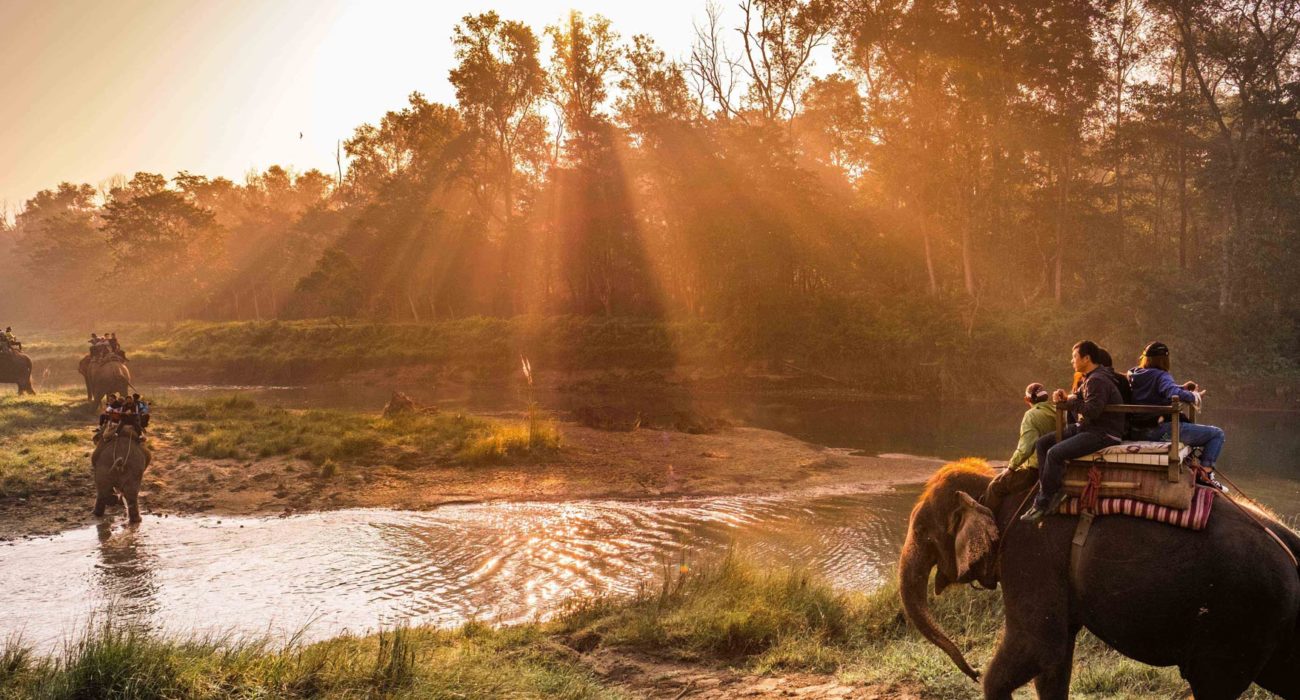
Chitwan National Park
Safaris, tigers and rhinos in Nepal's first national park — a UNESCO World Heritage site in the jungle of the Terai.
 Destinations
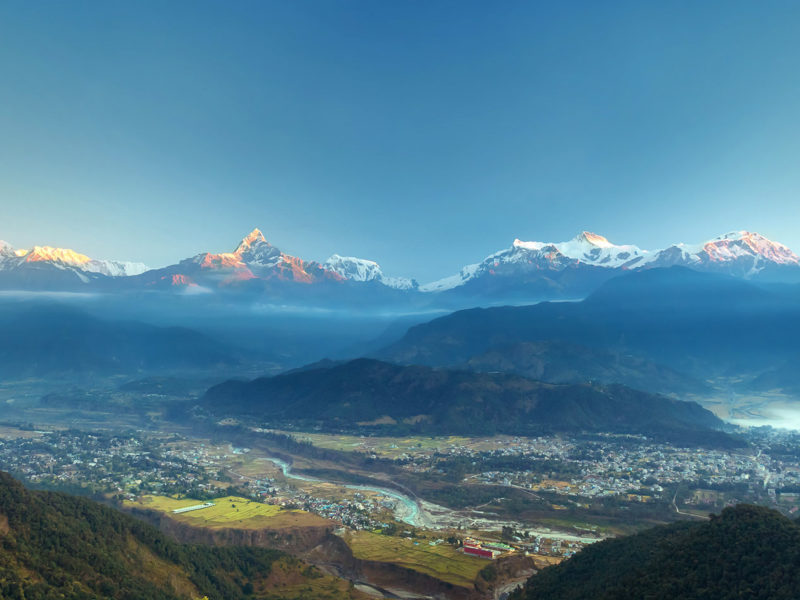
Pokhara, Nepal's Adventure Capital
Pokhara is Nepal's number-one destination for adventure & leisure: Fewa Lake, Lakeside, Sarangkot, paragliding, zipline and the gateway to Annapurna trekking — a full guide with costs in euros and a 3-day plan.
 Destinations
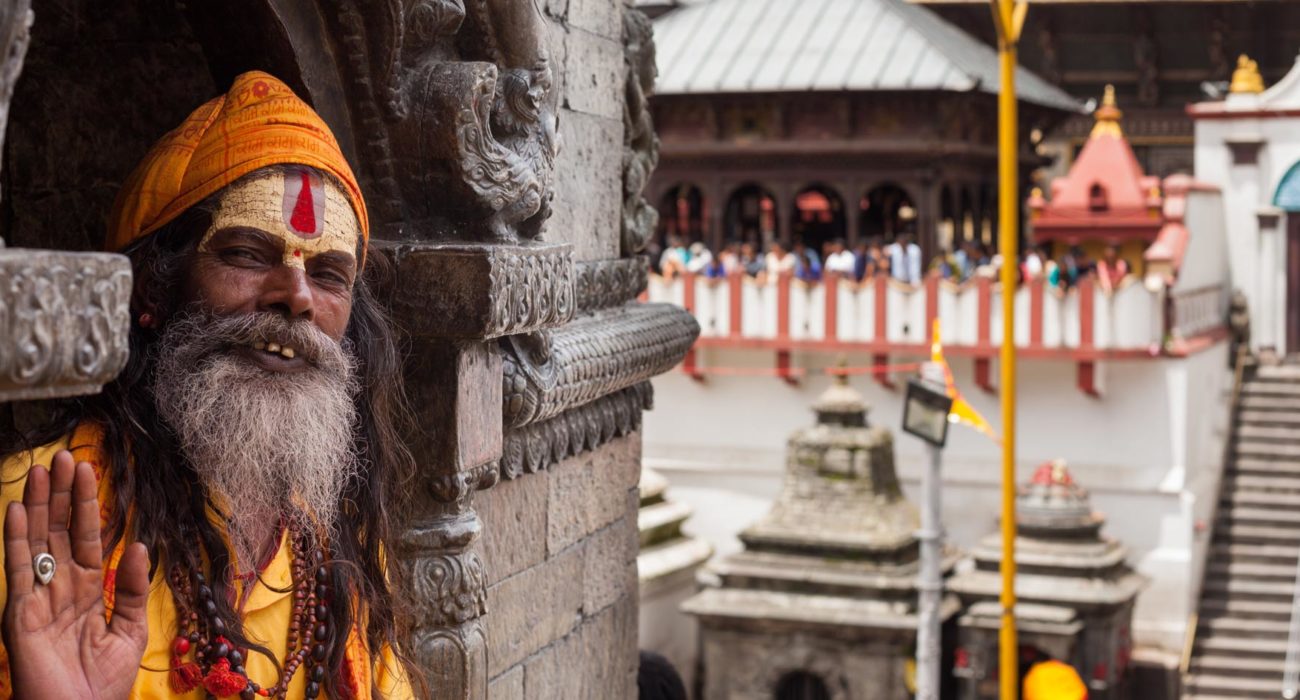
Kathmandu, the Capital of Nepal
Kathmandu is a living museum — 7 UNESCO sites, ancient Newari architecture, Hindu temples, Buddhist stupas and the living goddess Kumari.