
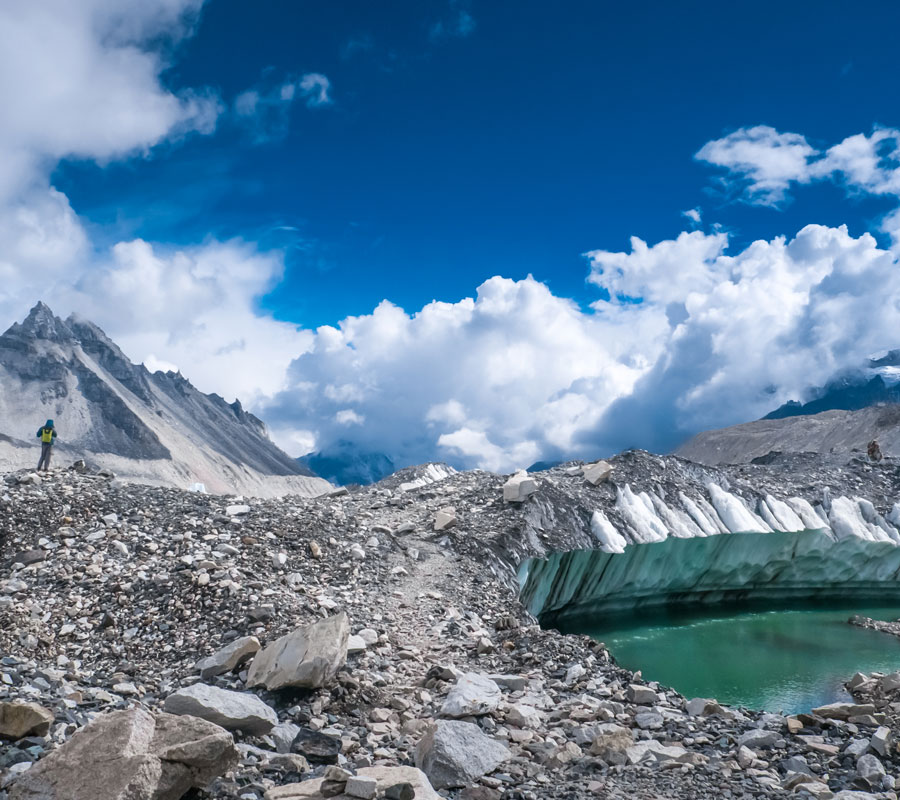
Everest Base Camp is the trek most often cancelled out of fear, and in my judgement it is the most unfair cancellation of all. If you saw the images from Rasuwa and had Everest booked for October, you are asking the same thing: should I forget it?
The short answer is that the flood did not touch the Khumbu valley. It is a different mountain range, a different river system, many tens of kilometres away from the disaster area. As of 5 September 2026, the Everest region (Base Camp, Gokyo) is open, and trails, lodges and flights to Lukla are operating normally.
In this article I explain the geography first, so you can see for yourself why it was not affected. Then I go through what stays the same (pace, acclimatisation, lodges, permits, gear, flights) and what really does change. The current picture is kept in the living article on Nepal after the floods, which is updated as the situation develops.
Why geography answers half the question
The disaster happened in Rasuwa, north of Kathmandu on the border with Tibet, and came down through the Bhote Koshi and Trishuli valleys. Those are the rivers that hit villages, bridges and the road to Rasuwagadhi. Everest has nothing to do with that river system.
Everest sits in the Khumbu valley on the eastern side of the country, in a different range from Langtang. The trail starts at Lukla and follows other riverbeds, other slopes, other villages. What came down from Langtang Lirung had no route into the Khumbu, and the same goes for the hillsides you actually walk on.
I say this because fear usually comes from the word Nepal in a headline, not from any real connection. The country is big and mountainous, and two valleys can be much further apart than a small map in your head suggests. Look at a proper map and you will see that Rasuwa and the Khumbu are different worlds.
What the current status says about the Everest region
According to the living article (5 September 2026), the Everest region (Base Camp, Gokyo) is open, and domestic flights are operating normally, without interruption. The same is true of Annapurna and the Manaslu Circuit, and Kathmandu, Pokhara and Chitwan are also operating.
Still closed are the Rasuwa district, the Langtang Valley, Gosaikunda and the banks of the Trishuli and Bhote Koshi, as well as the land crossings to Tibet. None of them lies on the route to Everest Base Camp. The Kathmandu–Pokhara road is closed at Krishnabhir, but that matters only if you plan to combine Pokhara with your trip; it plays no role for Lukla.
This information is dated 5 September. Since your trip will happen later, check the living article again shortly before you leave and ask your local agency about the situation in those days.
What stays exactly the same: pace and acclimatisation
Everest Base Camp did not become easier or harder because of the flood. Its difficulty is the same threefold thing as ever: many days of walking, the altitude, and the constant ups and downs of the valley. It needs no technical climbing, but it needs patience.
Acclimatisation remains the first rule. The rest days at Namche and Dingboche are not optional, and a slow pace is strategy, not weakness. Everything you have read in the Everest Base Camp guide applies unchanged. If altitude symptoms worsen, the answer is still to descend, and for medical questions such as preventive medication you speak to your own doctor before the trip.
I stress this because I often hear people say that after all this they should cut days and go faster. It is the opposite. Pressure to make up for lost time is the worst reason to squeeze a schedule at altitude.
Lodges and permits: the daily reality of the trail
The lodges (teahouses) in the region are operating normally, according to the current status. The experience is the familiar one: simple rooms, a shared dining room with a stove, dal bhat as fuel. The higher you climb, the more basic and more expensive things become, because everything comes up by porter or animal, and that has nothing to do with the flood.
Permits have not changed. For Everest you need the national park permit and the local municipality permit for the Khumbu area. The fees are set by the national park and the local Khumbu municipal authority and can change, which is why I write no amounts here; you confirm the current requirements with your agency or official sources before travelling. For how the whole system works, see the guide to trekking permits in Nepal.
The licensed-guide rule in force since 2023 stays as it is too, with the caveat that enforcement and details should always be checked with an official source. Cancelling now saves you nothing at this level; you just lose your planning.
What you pack
The Everest gear list does not change. It is still the layering system, boots you have already broken in, a sleeping bag suited to cold nights, a down jacket for the hours you sit still, and a small first-aid kit that you have discussed with your doctor. You will find all of it in the guide on what to pack for Nepal.
Autumn has a reputation for clear skies and steadier conditions, but mornings and evenings at altitude are cold regardless. Do not underestimate your clothing because it is the good season. And do not forget cash, chargers and the weight limit on the small planes to Lukla, which applies whatever the season.
The flood adds no equipment obligation. You need nothing special for the Khumbu. Travel insurance with altitude and evacuation cover remains, as always, the most important item that does not fit in your backpack.
Flights to Lukla and their weather
According to the current status, flights to Lukla are operating normally and domestic flights generally run without interruption. That is the critical point for Everest, because the trek starts and ends with the flight.
What does not change is the role of the weather. Flights to Lukla depend on visibility and wind, and delays or cancellations can happen on any day, in any season, with or without floods. That is why I always recommend a buffer of a day or two in the schedule, especially before the return flight and your international connection.
In busy periods flights are sometimes organised from another airport, such as Ramechhap, so confirm with your agency exactly where you will depart from. Schedules change, and that is something you check before the trip and again a few days before departure.
What really changes: more demand on fewer routes
I will not tell you everything is the same, because it is not. With Langtang and Gosaikunda closed, many travellers who had those routes in mind are turning to Annapurna, Everest and Manaslu. That means more demand on fewer routes in the same season.
In practice that can mean fuller lodges at popular stops, less flexibility on dates and busier flights on some days. I see it as a reasonable expectation, one you confirm with your agency for your own dates. My advice is simple: book early, leave a margin and do not wait until the last minute for accommodation.
Cost is also shaped by such factors: season, group size, length, comfort level and flight availability. The price is set per trip, which is why I write no figures. If you need a real picture for your own case, ask us for a quote and we will answer based on your dates.
A cancellation out of fear costs the people of the mountains
There is also an ethical side, and I say it as someone who lives here. A guide, a porter or a family running a lodge in the Khumbu was not flooded. But their work depends on whether travellers come. A cancellation out of fear of something that did not touch them takes their season away without helping anyone.
At the same time, the people of Langtang lost their work because the area is closed. If you had booked Langtang, my suggestion is to switch to Everest, Annapurna or Manaslu, ideally with the same guide and the same local agency, so the work stays with the same people.
My general conclusion from living here is that after a crisis local communities usually ask for work, not sympathy from a distance. I am not asking you to go anywhere that is closed. I am asking you to decide from the map and the current status, not from the photo you saw on the news.
How to decide and what to confirm before you leave
The table sums up what stays the same and what needs attention. Each item marked confirm can change, so ask your agency close to departure.
If you travel via Pokhara or are thinking of combining routes, remember that the Kathmandu–Pokhara road counts as closed until its reopening is officially announced, and that flying is the safer choice. The current status gives no reopening date, so check again close to your trip.
| Topic | What holds | What you confirm |
|---|---|---|
| Everest region | Open as of 5 September 2026 | The picture in the living article before you go |
| Lukla flights | Operating normally | Departure airport and buffer days |
| Lodges | Operating normally | Availability on your dates |
| Permits | Required as always | Current requirements and fees from your agency |
| Langtang, Gosaikunda | Closed | Do not plan them; swap them |
My bottom line
If you had Everest Base Camp booked for this autumn, the flood alone is not a reason to cancel. The Everest region is open and trails, lodges and flights to Lukla are operating normally (as of 5 September 2026), and the acclimatisation schedule stays the same. What changes is demand, and the need to organise a little earlier.
If you have hesitations for your own reasons, such as health, time or budget, those are legitimate and you should weigh them. Just do not confuse them with a fear that does not correspond to your route.
For the picture of the day, go back to the living article on Nepal after the floods before you make your final decision.
Frequently asked questions
- No. Everest sits in the Khumbu valley, in a different mountain range and river system, many tens of kilometres away from Rasuwa. As of 5 September 2026 the region was open. Check the living article for the latest picture before you travel.
- According to the status as of 5 September 2026, flights to Lukla are operating normally. Weather can still delay or cancel flights on any day, so keep buffer days in your plan and confirm the departure airport with your agency before you go.
- No. Acclimatisation, a slow pace and the rest days stay the same because the altitude has not changed. Do not cut days to make up for lost time. For medical questions, such as preventing altitude sickness, speak to your own doctor before you leave.
- No, permits and gear have not changed because of the flood. Fees are set by the national park and the local Khumbu municipal authority and can change, so confirm the current requirements with your local agency or official sources before you travel.
- With Langtang and Gosaikunda closed, more travellers are turning to Everest, Annapurna and Manaslu. Expect more demand on fewer routes, so book early and leave margin in your dates and flights. Confirm availability with your agency before committing.
- Yes. Langtang remains closed, and switching to Everest, Annapurna or Manaslu is the sensible solution. Ideally keep the same guide and the same local agency so the work stays with the same people. Pricing is shaped per trip, so ask for a quote.
- There is no single price. The cost is shaped per trip and depends on the season, group size, length, acclimatisation profile, comfort level and flight availability. For a real picture based on your dates, ask for a quote through our contact page.
Keep reading
Related articles
 Activities
Trekking in Nepal: The Complete Hiking Guide
The definitive guide to trekking in Nepal: teahouse trekking, the main regions, a comparison of the top treks, permits, seasons and how to choose your route.
 Trekking
Annapurna: The Complete Trekking Guide to Nepal's Most Popular Region
The Annapurna massif, the top routes (ABC, Circuit, Poon Hill, Mardi Himal, Tilicho), the ACAP permit, seasons, sample itineraries and how to choose.
 Trekking
Annapurna Base Camp Trek (ABC): The Complete Guide
The 'amphitheatre of the gods' at 4,130m: a day-by-day itinerary, difficulty, ACAP permits, seasons and how to combine it with Poon Hill.