
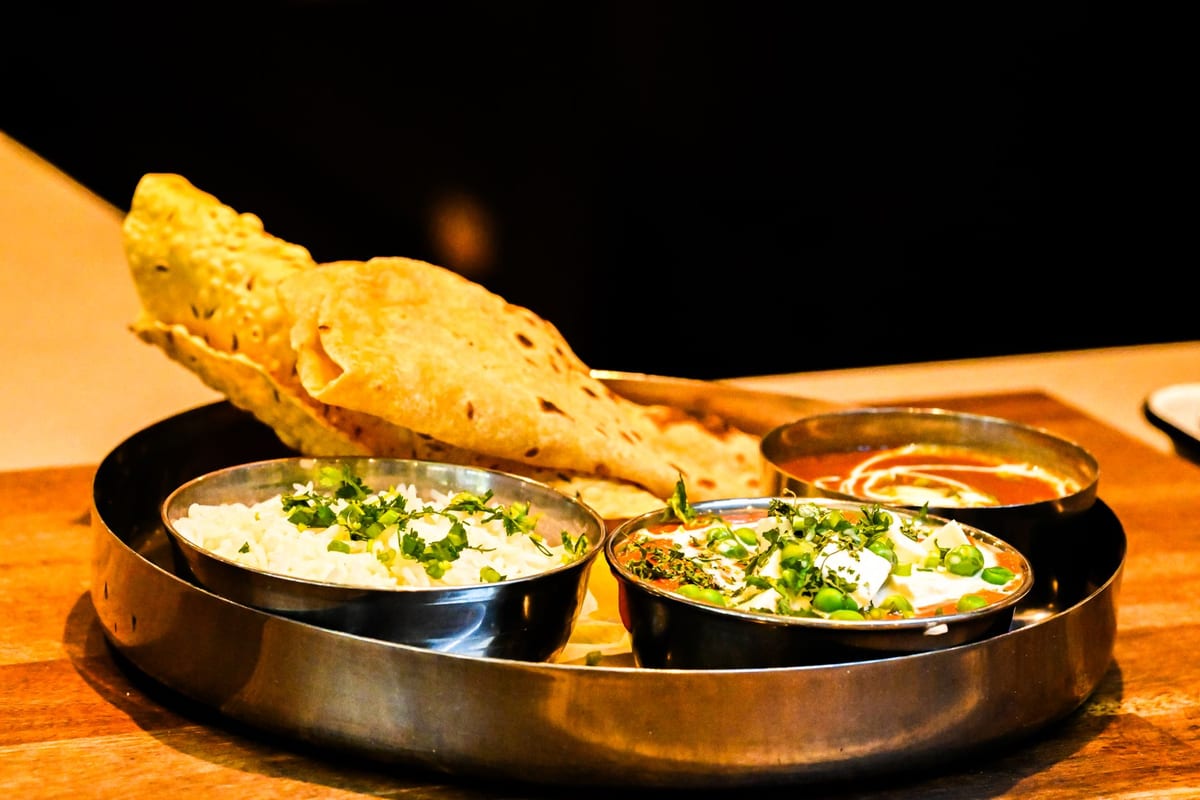
If you're worried about eating vegetarian or vegan in Nepal, relax — it's one of the easiest countries in Asia for it. Nepal has a strong Hindu tradition where vegetarian food is abundant and completely normal — the everyday dal bhat plate is plant-based by default, and meat is often kept for festivals or limited by cost. Everyday cooking is built around lentils, rice, vegetables and pulses. You don't need to hunt for specialist restaurants on every corner — vegetarian food is everywhere, cheap and tasty.
The real challenge is a bit different from what you might expect. It isn't a lack of options, but the line between vegetarian and vegan. Nepali cooking often uses ghee (clarified butter), milk and yoghurt — from rice to tea. If you're vegan, a menu item marked "vegetarian" doesn't automatically mean "free of animal products."
This guide covers the practical side: how dal bhat works, where ghee and milk hide, what's going on with eggs, how to order with confidence, what to expect around monastery areas and at trekking lodges, and a handful of useful Nepali phrases. Exact conditions vary from one kitchen to the next — the best habit is to ask rather than assume.
Why Nepal is easier than you'd expect
The majority of Nepalis are Hindu, and within much of that tradition vegetarianism is seen as a more "pure" choice, especially around religious observance. Many families eat meat rarely, usually for festivals or when the budget allows, and the everyday table is vegetarian by default: lentils, rice, seasonal vegetables, pickle. That means you don't have to chase down vegetarian options — in a lot of places it's simply the default way of eating.
The cow, on top of that, is sacred to Hindus and slaughtering one is illegal in Nepal — beef is effectively absent from Nepali menus (the red meat you will see is buff, i.e. water buffalo). Combined with the Buddhist presence in monasteries and communities, this creates a food culture where vegetarian cooking isn't an afterthought but a central part of the identity. To understand this backdrop better, it's worth reading our guide to culture and etiquette in Nepal.
Dal bhat: the backbone of vegetarian eating
Dal bhat — rice, lentils, vegetables and pickle, often with a free refill — is the national dish and, at the same time, the safest vegetarian option almost everywhere, from the simplest shack to the most touristy restaurant. It's cooked fresh, filling and nearly always available, even in places where the rest of the menu is limited.
The point to watch is that traditional dal bhat often contains ghee — in the rice, the lentils, or both. If you're vegan, ask for it "bina ghiu" (without ghee/butter), or simply "vegan dal bhat" in more touristy areas, where staff are used to the request. In more remote places, don't be surprised if you need to explain a little more — patience pays off here.
Ghee, milk and yoghurt: the big issue for vegans
If one thing will trip you up as a vegan in Nepal, it's dairy. Ghee and butter turn up often enough in cooking that you should always ask, but a lot of everyday cooking — at home and in teahouses — uses mustard oil or soybean oil instead, so the answer varies from kitchen to kitchen. Yoghurt (dahi) is central to festivals and desserts, and tea is served with milk (milk tea or masala chai) by default unless you ask otherwise. Paneer (fresh cheese) also shows up often in vegetable dishes as a protein source.
The good news is that in the big cities and the more touristy spots, the word "vegan" is now fairly well recognised, and many cafés offer alternatives — black tea without milk, black coffee, or food cooked in vegetable oil instead of ghee on request. In more remote areas, though, milk and ghee are so woven into the cooking that avoiding them completely takes constant vigilance and, sometimes, a small compromise.
Eggs: where they hide and how to ask
Eggs are the grey area between vegetarian and vegan eating in Nepal, much as they are elsewhere. Practice varies here: many vegetarians in Nepal avoid eggs entirely, while others include them. That's exactly why a dish marked "veg" can still contain egg, especially in baked goods or anything made with dough — it's worth asking directly.
Momo (Nepali/Tibetan steamed dumplings) usually have an egg-free vegetable filling, but the dough can occasionally contain egg — worth asking if you're not sure. Baked treats in tourist cafés (cakes, biscuits) very often contain egg unless explicitly marked "egg-free" or "vegan." The simple rule: if it isn't stated, ask — the word "phul" means egg in Nepali (the Hindi word "anda" is understood in many places too).
How to order safely: key words
The word "shakahari" means vegetarian and is recognised almost everywhere, even in small shops with no English menu. Less widespread but increasingly understood is the word "vegan" itself, especially in cities and tourist-heavy spots. In simpler places, the phrase "bina dudh, bina ghiu, bina phul" (no milk, no ghee, no egg) is clearer than a general "vegan," which may not always be fully understood.
Good practice is to always ask in simple, specific terms rather than assuming from a menu description — the same principle applies to food safety in Nepal generally, as we explain in our guide to health in Nepal: favour food that's freshly cooked and served hot, which holds true for vegetarian and vegan travellers alike.
Monastery areas and Buddhist cuisine
Around major Buddhist centres, such as Boudhanath in Kathmandu, you'll find plenty of restaurants with clearly marked vegetarian and sometimes vegan options, since the area is home to a large Tibetan community with a rich tradition of vegetable-based dishes, such as thukpa (noodle soup) and vegetable momo.
Always keep in mind that "vegetable thukpa" or "veg momo" may be cooked in a meat-based broth or in the same kitchen as meat dishes — if that concerns you, ask directly. Inside the monasteries themselves, practice varies a lot: some Theravada or Newar Buddhist settings keep to strict vegetarian food, while many Tibetan Buddhist monasteries commonly serve meat too — there's no blanket vegetarian rule in Himalayan Buddhism. Never assume a monastery meal is vegetarian; ask. Visitor access to a monastery kitchen is rare anyway — the restaurants nearby are your more realistic option.
Trekking lodges: vegetarian food in the mountains
On Nepal's trekking trails, dal bhat reigns for practical reasons too: at altitude, the cold chain for meat is unreliable, so many trekkers — even meat-eaters back home — go vegetarian for the days of the trek. That makes teahouses especially vegetarian-friendly, with dal bhat, vegetables, rice and soup almost always available.
For vegan travellers the picture is more mixed: many teahouses use ghee or yak butter in cooking and in the famous butter tea, and protein options thin out at higher altitude. In my experience, the most realistic plan is to ask for dal bhat without ghee at every stop in advance, carry some nuts or protein bars as backup, and not expect much variety above 3,000 metres.
Kathmandu and Pokhara: the vegan scene in the cities
In Kathmandu, especially around Thamel, and along Pokhara's lakeside strip, vegan culture has grown considerably in recent years, with cafés and restaurants offering a dedicated vegan menu or clear labelling. This is a fairly recent development, so specific places open and close often — better to check current reviews before you go than to rely on an old list.
Beyond the dedicated vegan spots, the structure of Nepali and Indian menus itself helps: dishes such as aloo (potato), gundruk (fermented leafy greens), chana (chickpeas) and various vegetable salads are often already vegan or become so with a simple modification. The Indian kitchens found all over Kathmandu also offer plenty of vegan-friendly, lentil-based dishes.
Street food: what to watch for
Nepal's street food is a joy but calls for a little care, not just for dietary reasons but for general food safety too — something we cover in detail in our guide to health in Nepal. Many street snacks are built around vegetables and pulses, but the batter or frying oil can contain ghee.
Sel roti, the ring-shaped sweet rice bread, is traditionally made with milk and sometimes egg — worth asking about before you try it if you're vegan. As a rule, the simpler and more "bare" a street food is (boiled vegetables, fruit, plain rice), the easier it is to know exactly what you're eating.
Useful phrases in Nepali
A handful of basic phrases make a huge difference, especially in places with less English. You don't need flawless pronunciation — the effort itself is appreciated and usually helps staff understand exactly what you want.
These phrases cover most situations. For anything else, a simple "no meat, no milk, no butter, no egg" in English is usually understood in the more touristy areas.
| What you want to say | Nepali (approximate) |
|---|---|
| I'm vegetarian | Ma shakahari hun |
| I'm vegan | Ma vegan hun — bina dudh, bina ghiu, bina phul |
| No milk | Bina dudh |
| No ghee / butter | Bina ghiu |
| No egg | Bina phul |
| Is there meat in this? | Yasma masu cha? |
| Thank you | Dhanyabad |
A last-minute practical checklist
Nepal will almost never leave you hungry as a vegetarian — dal bhat and its countless regional variations turn up in nearly every corner of the country, from Thamel to the smallest village along a trek. As a vegan, the picture is a bit more mixed because of how much ghee and milk run through a lot of the cuisine, but it's far from impossible — it just takes a bit more attention and a few extra questions at every new place.
With the right words and a little flexibility, you'll eat well the whole way through, from restaurants in Kathmandu to the simplest teahouses on the highest trails. Keep the points below in mind before and during your trip — you don't need to memorise all of them, just have them ready when you order. For the bigger picture of planning your trip, start with our complete Nepal travel guide.
- Always ask for dal bhat "bina ghiu" if you're vegan — it's the most reliable option almost everywhere
- Ask explicitly about ghee, milk and egg at every new place, even if the menu says "veg"
- At trekking lodges, carry some nuts or protein bars as backup at high altitude
- In the cities, check recent reviews for vegan-friendly places before you go — the scene changes fast
- Remember the "jutho" custom (don't share bites or drink directly from someone's bottle) described in our guide to culture and etiquette — it helps with your food hygiene too
Keep reading
Related articles
 Articles
The biggest help you can give Nepal is to visit
On 26 August 2026 a piece of mountain turned into water and took villages, bridges and more than a thousand lives with it. I have lived here for fifteen years. Here is what happened, what is open, how you can help today, and why your trip in October is the biggest help of all.
 Info
InfoWhat Is the Climate Like in Nepal?
Everything about Nepal's climate — four seasons, three climate zones, temperatures by region and when the sky is clear for the Himalayas.
 Info
InfoThe Best Time to Visit Nepal
When should you travel to Nepal? A decision guide by activity — trekking, safari, culture — with a table, crowds, prices and festivals.