
When people ask me "what's the weather like in Nepal?", my first answer is always a question back: "which Nepal?". Because within a country smaller than Greece with its islands, the land climbs from ~60 metres of subtropical plain to the 8,849 metres of Everest — and the climate changes radically with it. On the same January day, one traveller can be sweating on safari in Chitwan while another shivers at -18°C on a Himalayan pass. Nepal's "climate", then, isn't one — it's many, stacked vertically one above the other.
In this guide we look in detail at what the weather is actually like: the three climate zones, the four seasons one by one (with their pros and cons), a table of temperatures by region, and how the great festivals "clip" onto the weather calendar. It's part of our overall Nepal travel guide. If what you're really after is the "when should I go" decision based on what you want to do, this article's sibling — the best time to travel to Nepal — has the full activity-by-month matrix.
Three countries in one: Nepal's climate zones
Before we talk about seasons, we need to understand altitude — because in Nepal altitude defines the weather far more than the month does. The country splits into three broad climate zones running parallel, from south to north.
Terai — the hot subtropical plain (60–300 m)
In the south, along the border with India, stretches the Terai: a low, fertile plain with a subtropical climate. It's hot here almost year-round, with summers topping 35–40°C and high humidity. It's also the area that takes the heaviest monsoon rains. Winter, however, is mild and sunny (18–24°C at midday), which is why Chitwan National Park is best visited in the cool season, when animals gather at the water and the weather allows comfortable safaris.
The hills in the middle — the temperate "core" (800–2,500 m)
In the middle of the country, among the green hills, lie the two cities almost every traveller will see: Kathmandu (~1,400 m) and Pokhara (~820 m). This zone has Nepal's most comfortable, temperate climate and the four clear seasons we describe below. Note one detail: Pokhara, lower and closer to the mountains, is noticeably warmer but also far wetter than Kathmandu — it receives among the highest rainfall in the whole country.
The high Himalaya — alpine & arctic (above 3,000 m)
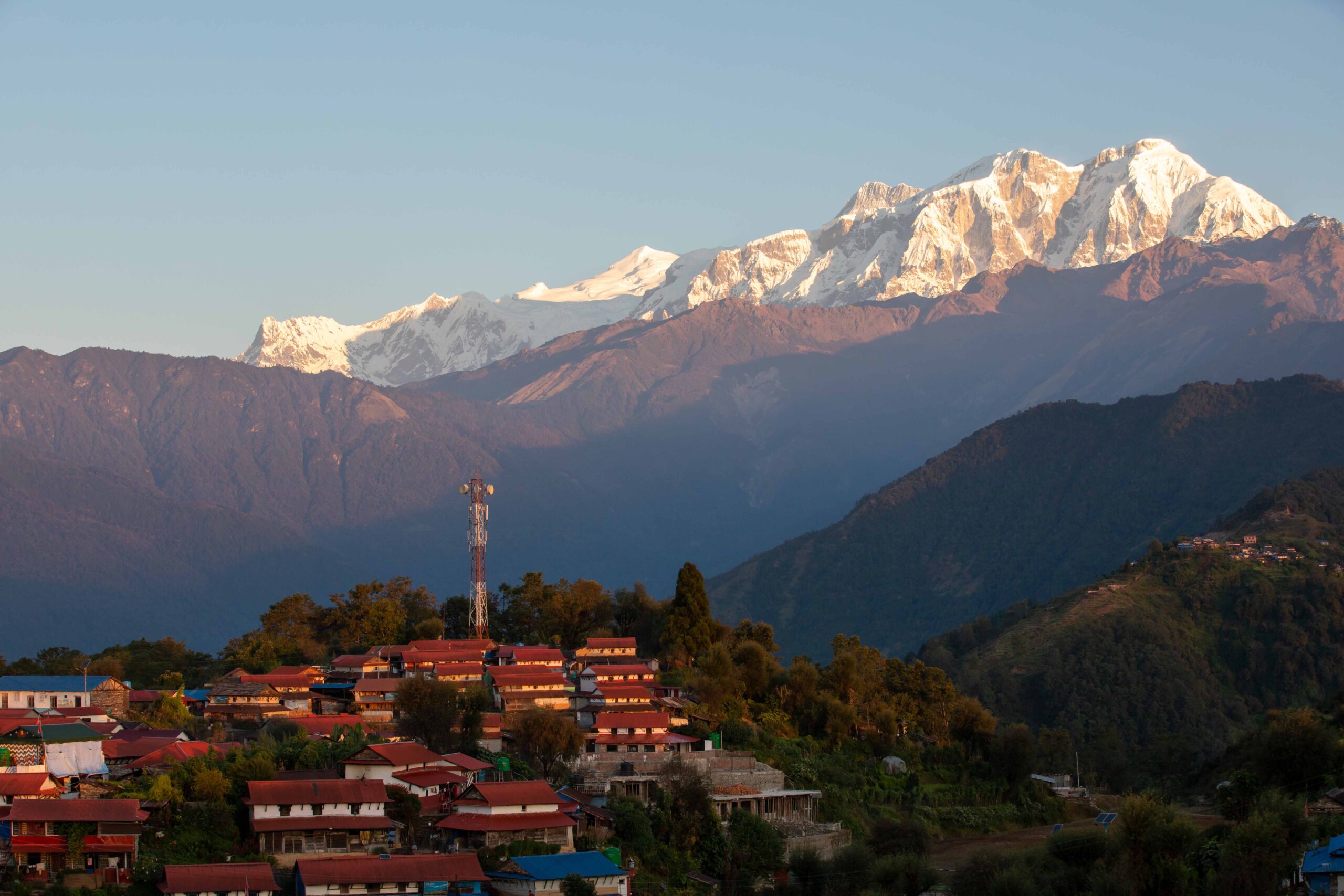
The higher you go, the further the mercury falls: roughly 6°C per 1,000 metres. Above 3,000 metres the climate turns alpine, above ~5,000 metres the permanent snow begins, and on the great peaks conditions are arctic all year. Here day and night live in different seasons: a sunny midday at 4,000 metres can be pleasant in a fleece, while the same spot after sunset plunges well below freezing. This zone is the world of trekking — and the reason layering isn't optional.
Nepal's four seasons
Within these zones, the year runs through four clear seasons, with the monsoon acting as the great "switch" that divides the dry half of the year from the wet.
Spring (March – May)
Spring is one of the two top seasons. The weather warms gradually, the lowlands become summery, while the mid altitudes stay pleasant. Its signature is the rhododendrons, which bloom crimson on the slopes (March–April) and turn the trails into a garden. It's also the main season for climbing the great peaks.
Pros: warm days, blooming nature, long daylight. Cons: as May progresses, the air grows "hazy" from dust and humidity, so mountain visibility isn't as crystal-clear as in autumn. The lowlands (Terai) start to become stifling toward the end.
Monsoon / Summer (June – September)
The monsoon brings ~80% of the annual rainfall. It doesn't rain all day non-stop — usually heavy showers fall in the afternoon and at night, leaving mornings that clear up. The landscape becomes dazzlingly green, the rice paddies fill with water and the waterfalls swell. The peaks, though, are often hidden behind cloud, roads are at risk of landslides and leeches appear on the trails.
Pros: few tourists, low prices, a more authentic picture of the countryside — and the "rain shadows" behind the Himalayas (Upper Mustang, Dolpo) that stay almost dry and become ideal destinations precisely in this season. Cons: humidity, mud, delays on flights and roads, limited mountain views.
Autumn (October – November)
If there is one "perfect" season for Nepal, this is it. As soon as the monsoon departs, the air stays washed clean and transparent: Himalayan visibility is the best of the whole year and the peaks stand sharp against a deep blue sky. Temperatures are comfortable, nights cool but not extreme, and conditions stable. It's the peak season for trekking and the backdrop of the great festivals.
Pros: unrivalled views, stable weather, festive atmosphere. Cons: it's also the busiest period — full teahouses, pricier tickets, the need to book early.
Winter (December – February)
Winter is dry and often sunny, but cold — especially at altitude. At low and mid elevations the days are pleasant and the sky clear, ideal for culture in the cities and safaris in Chitwan. Up high, however, the nights are freezing, the teahouses have no heating and the great passes (e.g. Thorong La) can close with snow. Low treks such as Poon Hill remain feasible with good preparation.
Pros: fewer people, clear days, cheaper prices, an excellent season for the Terai and the cities. Cons: cold at altitude, morning fog that can delay flights, high passes closed.
Temperatures by region & season
The table below gives indicative temperature ranges (daytime min–max) for the two main urban centres and for a typical trekking altitude (~3,500 m). Remember that in the Terai (Chitwan, Lumbini) you should add roughly 5–8°C to Kathmandu's figures, especially in summer.
| Season | Kathmandu (1,400 m) | Pokhara (820 m) | High altitude (3,500 m+) |
|---|---|---|---|
| Spring (Mar–May) | 12–28 °C | 16–30 °C | -5 to 12 °C · nights below freezing |
| Monsoon (Jun–Sep) | 20–29 °C · humid | 21–31 °C · heavy rain | 2–15 °C · fog & snow up high |
| Autumn (Oct–Nov) | 10–25 °C | 13–27 °C | -8 to 10 °C |
| Winter (Dec–Feb) | 2–19 °C | 6–20 °C | -15 to 5 °C · nights to -25 °C |
The key takeaway: don't translate temperature into "clothes" based on the month, but based on altitude and time of day. The same day may call for a sun hat at midday and a -10°C jacket at night. That's why you should look carefully at what to pack for Nepal — layering is your real "climate control".
The climate against a backdrop of festivals
The weather doesn't run in a vacuum: onto it "sits" one of the richest festival calendars in the world. Combine season and festival well, and the trip takes on a whole other dimension (more in our guide to Nepal's culture and customs).
- Autumn = the great festivals. Exactly when the weather is perfect, the two most important festivals fall: Dashain (Sep–Oct, 15 days) and shortly after Tihar (Oct–Nov), the Nepali "festival of lights". The country is festive and beautiful — but shops may close and buses can be packed.
- Late winter = colour and spark. February–March bring Maha Shivaratri (with thousands of sadhus at Pashupatinath) and Holi, the "festival of colours" that welcomes spring with coloured powder in the streets.
- Winter = golden fields. In the dry season, the fields turn yellow with blooming mustard — an iconic image of the Nepali countryside. See the mustard season in Nepal.
- Monsoon = green & quiet. Fewer tourists, lush landscapes and low prices — for anyone not chasing the peaks, it has its own charm.
In brief: the best season by activity
A quick look to connect climate with activity. You'll find the full "what to do by month" matrix in the sibling guide: the best time to travel to Nepal.
| Activity | Ideal season |
|---|---|
| High-altitude trekking | Autumn (Oct–Nov) & Spring (Mar–Apr) |
| Low-altitude hiking (e.g. Poon Hill) | Year-round except monsoon · good in winter too |
| Safari in Chitwan | Winter & early spring (Oct–Mar) |
| Culture & cities | Year-round · ideally autumn & spring |
| Green landscapes & few tourists | Monsoon (Jun–Sep) |
Travel in the right season — a guided journey
Nepal's climate isn't an obstacle; it's a tool. When you know what the weather is like where and when, you can build a trip that gives you clear peaks, mild temperatures and the right scenes at every moment. The hard part is coordinating season, altitude, route and festivals — and that's where we come in.
At Elysian Himalaya, our premium partnership, we design tailor-made journeys that "clip" onto the climate: the right trek in the right week, the heated lodges where they matter, the timing with a great festival if you want it. With a Greek point of contact and a team on the ground, we make sure the weather works in your favour. nepal.gr gives you the knowledge — and whenever you like, we connect you with the team that turns it into a journey.
Gallery
Frequently asked questions
- January is consistently the coldest month. In Kathmandu nights drop to 1–3°C (with virtually never any snow in the city), while on the high Himalayan passes the temperature can fall below -20°C at night. Midday at low altitude, however, is often sunny and pleasant.
- Yes, as long as you know what to expect. From June to September it rains heavily (mostly afternoon/evening), the landscape turns lush green, prices drop and tourists thin out. The peaks are often hidden in cloud and there's a risk of landslides. For trekking, head to the rain-shadow areas — Upper Mustang and Dolpo — which stay almost dry.
- Practically no. Kathmandu sits at ~1,400 metres and snow on the valley floor is extremely rare (the last notable snowfall was decades ago). You'll see snow on the surrounding hills and, of course, on the mountains. Winter in the city means cold nights, morning fog and sunny middays.
- The Terai plain in the south (Chitwan, Lumbini, ~60–300 m elevation). In the summer months temperatures frequently exceed 35–40°C with high humidity, while even in winter middays are mild (18–24°C) — which is exactly why safaris are best done in the cool season.
- Right after the monsoon, in October and November, the atmosphere is washed clean by the rain and Himalayan visibility is the best of the whole year. The second-best window is the clear, dry days of winter. In late spring the air turns hazy from dust and humidity.
- Absolutely. The key principle is layering: on the same day you might have 25°C at midday and below freezing at night at altitude. See exactly what to bring in our guide on what to pack for Nepal.
Keep reading
Related articles
 Articles
The biggest help you can give Nepal is to visit
On 26 August 2026 a piece of mountain turned into water and took villages, bridges and more than a thousand lives with it. I have lived here for fifteen years. Here is what happened, what is open, how you can help today, and why your trip in October is the biggest help of all.
 Info
InfoThe Best Time to Visit Nepal
When should you travel to Nepal? A decision guide by activity — trekking, safari, culture — with a table, crowds, prices and festivals.
 Info
InfoTravel to Nepal: The Complete Guide from Greece
Everything a traveller from Greece needs to plan a trip to Nepal: when to go, visa, flights from Athens, permits, treks, health, SIM and a ready-made 14-day itinerary.