Nepal isn't just a destination with mountains. It's a living cultural crossroads where Hinduism and Buddhism have coexisted for centuries, where every street passes a temple and every month has a festival. For a traveller from Greece — a country with its own deep relationship with the sacred — this may be the most moving side of the journey: the sense that here faith isn't a museum exhibit but a daily act.
This guide gathers in one place everything you need to know about Nepal's culture and etiquette: the two great religions and how they intertwine, how to "read" a temple or a stupa, the major festivals you might encounter, the unwritten rules of respect that separate the tourist from the welcome guest, the unique culture of the Newar, and the country's most unusual custom: the living goddess Kumari. It's part of our overall Nepal travel guide.
Two religions, one culture: Hinduism & Buddhism
Until 2006 Nepal was the only officially Hindu state in the world; today it is a secular republic, but its Hindu identity remains dominant. According to the 2021 census, about 81% of Nepalis are Hindu and 8% Buddhist, with smaller communities of Muslims (5%), followers of Kirat (3%) and Christians (2%).
The percentages, though, say little. The reality in Nepal is a deep syncretism: many people honour Hindu and Buddhist deities at once, temples and stupas stand side by side, and whole communities — like the Newar of the Kathmandu Valley — don't split cleanly into two. It's not unusual to see a worshipper light a lamp at a Hindu temple and, a few metres on, spin a Buddhist prayer wheel.
And let's not forget: Nepal is the birthplace of the Buddha. Siddhartha Gautama was born around 563 BCE in Lumbini, on the southern plains — one of the holiest pilgrimage sites in all of Buddhism. For a traveller interested in culture, Nepal offers something rare: the chance to see both great religious traditions of Asia flourishing in the same place.
Temples and stupas: how to "read" them
The two religions have different architectural languages. The Hindu temple (mandir) is dedicated to a deity and often takes the classic Nepali pagoda form with multiple tiered roofs. The Buddhist stupa is a white hemispherical dome symbolising the enlightened mind of the Buddha, frequently painted with the "Buddha eyes" gazing out to all four directions.
Pashupatinath — the holiest Hindu pilgrimage
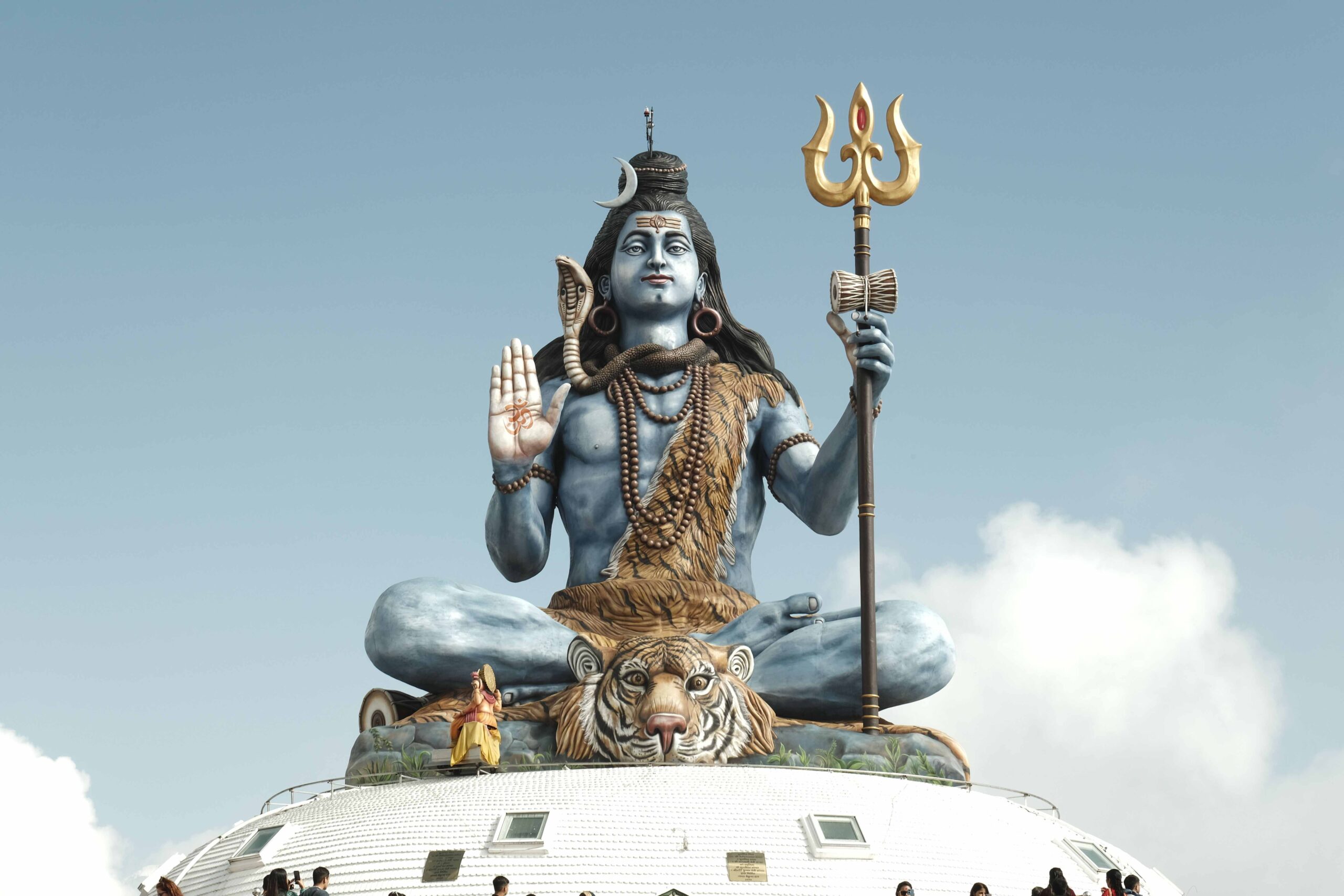
Pashupatinath temple, a UNESCO site on the bank of the Bagmati river in Kathmandu, is the holiest temple of Shiva in all of Nepal. The main sanctum admits only Hindus; everyone else admires it from the opposite bank. There, on the river ghats, the public cremations take place — a powerful, profound scene that calls for silence, respect and no photographs. The temple's great moment is the Shivaratri festival, when thousands of sadhus and worshippers flood the site.
Boudhanath & Swayambhunath — the great Buddhist stupas
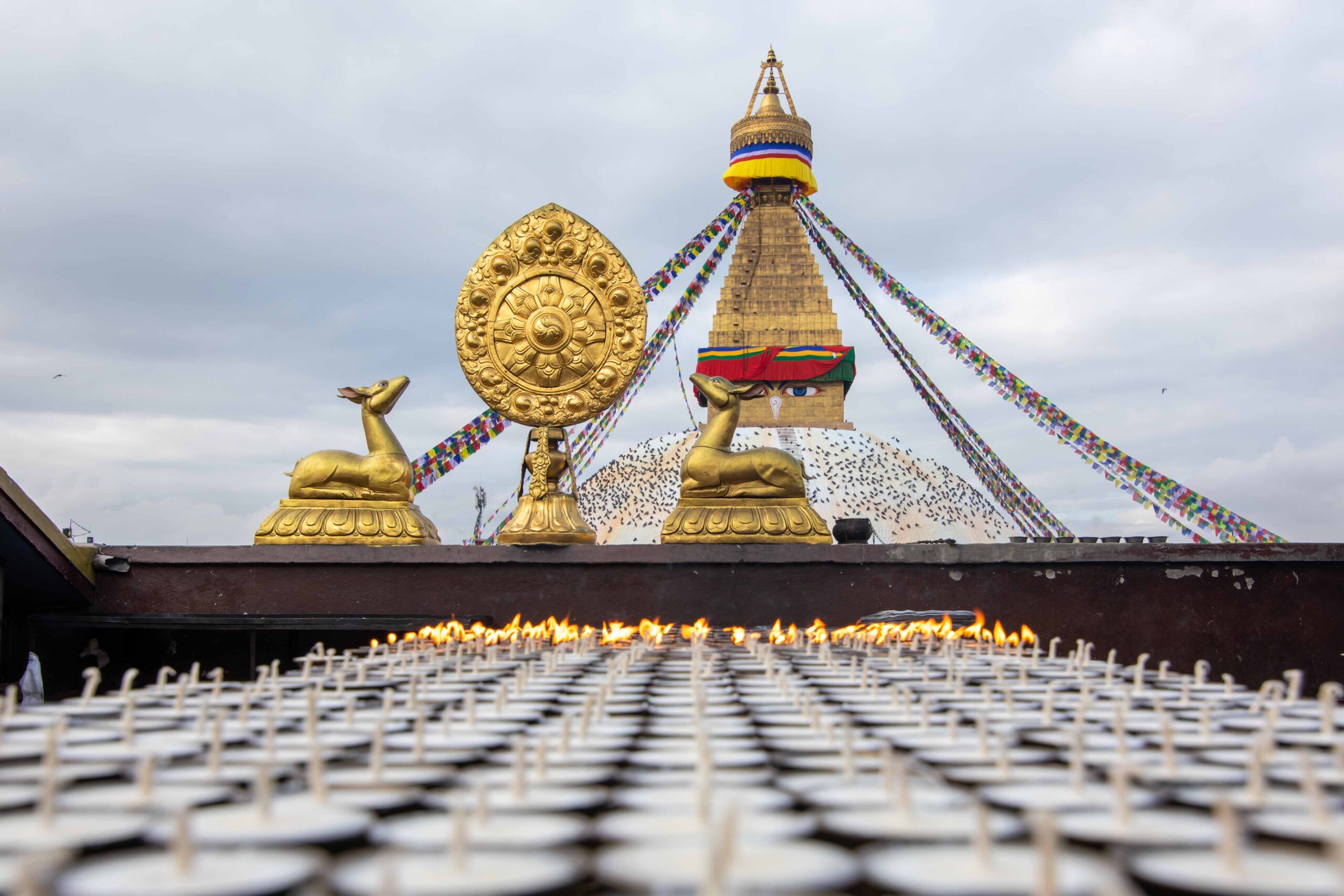
Boudhanath is one of the largest stupas in the world and the heart of Nepal's Tibetan Buddhist community. In the evening, hundreds of worshippers make the sacred circuit (kora) around it, lighting butter lamps. Swayambhunath, also known as the "Monkey Temple", stands on a hill above Kathmandu and is among the oldest shrines in the valley, its famous Buddha eyes surveying the city. Both are in the capital — see our dedicated guide to Kathmandu.
Prayer flags, wheels and the "kora"
Two symbols will follow you everywhere in Nepal. Prayer flags (lung ta) hang from every pass and rooftop in five colours, each with a meaning: blue (sky/space), white (air), red (fire), green (water), yellow (earth). The wind "reads" the prayers printed on them and scatters them across the world. Prayer wheels (mani), metal cylinders inscribed with the mantra "Om Mani Padme Hum", are always turned with the right hand and clockwise. The same rule applies to walking around stupas and temples: always clockwise, with the shrine on your right.
Nepal's great festivals
The Nepali calendar is full of festivals — it's said Nepal has more festivals than days in the year. Dates follow the lunar calendar, so they shift each year. If you'd like to time your trip with a festival, check our guide to the best time to travel to Nepal.
| Festival | When | What it is | What you'll see |
|---|---|---|---|
| Dashain | Sep–Oct (15 days) | The biggest festival, the goddess Durga's victory over evil | Family gatherings, red "tika" on the forehead, kites, closed shops |
| Tihar (Deepawali) | Oct–Nov (5 days) | The "festival of lights" — the Nepali Diwali | Thousands of lamps & candles, honouring crows, dogs & cows, Bhai Tika |
| Holi (Fagu Purnima) | Feb–Mar | The "festival of colours", welcoming spring | Crowds throwing coloured powder & water in the streets — wear "throwaway" clothes |
| Maha Shivaratri | Feb–Mar | The "Great Night of Shiva" | Thousands of sadhus, fires & chanting at Pashupatinath |
| Buddha Jayanti | May (full moon) | The Buddha's birth, enlightenment & death | Processions & pilgrimages at Lumbini, Boudhanath, Swayambhunath |
| Indra Jatra | Sep | The great festival of the Kathmandu Valley | Masked dancers & the Kumari goddess paraded on a chariot |
Etiquette: the unwritten rules of respect
Nepalis are among the most hospitable and tolerant people you'll meet — they won't "punish" you for a mistake. They know you're a foreigner. But a traveller who shows respect for the customs opens doors no money can open: smiles, conversations, invitations to tea. The basic rules are few and easy.
| ✅ Do | ❌ Avoid |
|---|---|
| Greet with "Namaste" and pressed palms | Shaking hands with the left hand — it's considered unclean |
| Remove your shoes before entering a temple or home | Entering a shrine or home with shoes on |
| Give & receive with your right hand (or both) | Handing money or food with the left hand only |
| Dress modestly at temples (shoulders & knees covered) | Shorts & sleeveless tops in sacred spaces |
| Circle temples/stupas clockwise | Pointing the soles of your feet at a person or deity |
| Ask before photographing faces & ceremonies | Touching someone's head (it's considered sacred) |
Namaste & the right hand. The greeting "Namaste" — palms together, a slight bow — means "I salute you" and covers hello, goodbye and thank you. The right hand is the "clean" one: you eat, give and receive with it. The left is traditionally linked to personal hygiene and avoided in social exchanges.
Shoes & feet. Always remove your shoes before entering a temple, a home, even some shops. Feet are considered the "lowest" and least clean part of the body: never point them at a deity, an altar or a person, and don't step on or over food or seated people. The head, by contrast, is sacred — don't pat anyone's head, not even children's.
Dress & leather. In temples and villages, dress modestly; a light shawl is invaluable for women. In many Hindu temples leather items (belts, bags) are forbidden, since the cow is sacred. In Thamel and tourist zones things are far more relaxed.
Photography & tipping. Ask permission before photographing people — the painted-faced sadhus often pose for a small tip. Don't photograph cremations, and respect no-photography rules inside shrines. On tipping: restaurants around 10% (there's often already a 10% service charge + 13% VAT on the bill), 100–200 rupees for porters, and rounding up in taxis.
The culture of the Newar
If one people holds the soul of the Kathmandu Valley, it's the Newar — the valley's indigenous inhabitants. To them we owe the astonishing architecture of the three royal squares (Durbar Squares) in Kathmandu, Patan and Bhaktapur: the carved wooden pagodas, the intricate windows and plazas that feel like open-air museums. The great architect Arniko, who in the 13th century carried the pagoda style all the way to China, was a Newar.
Newar culture is unique because it harmoniously blends Hindu and Buddhist elements, has its own language (Nepal Bhasa) and one of the richest cuisines in the region. A samay baji (a platter of beaten rice, grilled meat, beans and local liquor) or a juju dhau — the "king curd" of Bhaktapur — are experiences you won't find anywhere else. And almost every week, somewhere in the valley, there's a Newar festival with processions and music.
Kumari — the living goddess
Perhaps the most striking custom in all of Nepal: the Kumari, the living goddess. She is a young girl, usually chosen from the Newar Shakya caste, considered the earthly incarnation of the goddess Taleju (Durga). The selection follows strict criteria — the 32 marks of perfection (lakshanas) — and the girl then lives in the Kumari Ghar, the historic "house of the goddess" in Kathmandu's Durbar Square.
The Kumari appears rarely at her window, silently blessing pilgrims — and leaves her house only for a handful of festivals a year, chief among them Indra Jatra, where she is paraded on a wooden chariot. She remains a goddess until her first menstruation, when she returns to ordinary life and a new Kumari is appointed. The custom has drawn debate over children's rights, but it remains deeply rooted in Nepali identity. No photography is allowed at her window — simply stand, wait, and perhaps you'll see her.
Practical tips for respect
- The cow is sacred. Beef isn't served (and slaughtering a cow is illegal). You'll find buff (buffalo meat), chicken and goat instead.
- "Jutho" — the concept of pollution. Anything that has touched your mouth or plate is considered unclean for others. Don't offer a bite from your food or a sip directly from your bottle; pour water into your mouth without the bottle touching your lips, as locals do.
- Bargain with a smile. In markets (e.g. Thamel) haggling is normal, but keep it polite and light — it's not a battle.
- Don't give money to begging children. It encourages them to skip school; better to support local communities and businesses.
- Discretion in public. Overt displays of affection are avoided. Friends holding hands (even men) is common and carries no romantic meaning.
- The gentle head wobble (the "Nepali head wobble") means "yes / OK / I understand" — don't mistake it for a refusal.
Travel with respect — a guided journey
Nepal's culture truly reveals itself when you have someone to explain what you're seeing: why they light the lamp, what the mantra on the wheel says, which deity dwells in which temple. On our organised trips we build that bridge — local guides who open the doors of customs with respect, not as spectacle. For those who want a more personal, deeply cultural experience — a private tour of the three Durbar Squares, meetings with Newar craftspeople, timing the trip with a great festival — Elysian Himalaya designs premium journeys where culture isn't a footnote but the protagonist.
Nepal rewards you in proportion to your respect for it. A smiling "Namaste", shoes left at the temple door, a clockwise circuit around the stupa — small gestures that turn you from a spectator into a guest. And then, the country opens up.
Gallery
Frequently asked questions
- Most temples and all Buddhist stupas, yes. The holiest Hindu temple, Pashupatinath, admits only Hindus into the main sanctum — everyone else admires it from across the Bagmati river. Always remove your shoes and ask before entering an interior space.
- Press your palms together at your chest, bow your head slightly and say 'Namaste' (or the more formal 'Namaskar'). It's the universal greeting for hello, goodbye and thank you. Handshakes exist, but namaste is never wrong — especially with elders and inside temples.
- In temples and villages, yes: covered shoulders and knees, nothing revealing. In Thamel and tourist zones it's more relaxed. For women, a light shawl is practical — it covers shoulders or head whenever needed.
- Always ask permission before photographing faces, especially elders and sadhus (the latter often expect a small tip). Avoid photographing cremations at Pashupatinath and respect 'no photography' signs inside shrines.
- Yes, but discreetly. In restaurants around 10% (there's often already a 10% service charge on the bill, plus 13% VAT). For hotel porters, 100–200 rupees. Guides and porters on treks follow separate, more generous norms.
- Dashain, in September or October — fifteen days that bring almost the whole country to a halt. Tihar (the 'festival of lights') follows a few weeks later. Travel then and you'll see Nepal at its most festive, but with shops closed and buses packed.
Keep reading
Related articles
 Articles
The biggest help you can give Nepal is to visit
On 26 August 2026 a piece of mountain turned into water and took villages, bridges and more than a thousand lives with it. I have lived here for fifteen years. Here is what happened, what is open, how you can help today, and why your trip in October is the biggest help of all.
 Articles
Shivaratri in Nepal: The Great Night of Shiva
Maha Shivaratri at Pashupatinath temple: ash-covered sadhus, all-night fires, chanting and up to a million pilgrims. When it happens and how to experience it respectfully as a traveller.
 Articles
Nepal's Mustard Season: The Golden Fields
Every winter Nepal's countryside turns yellow with blooming mustard fields — when they bloom, where to see them, and why it's a dream for photography.