

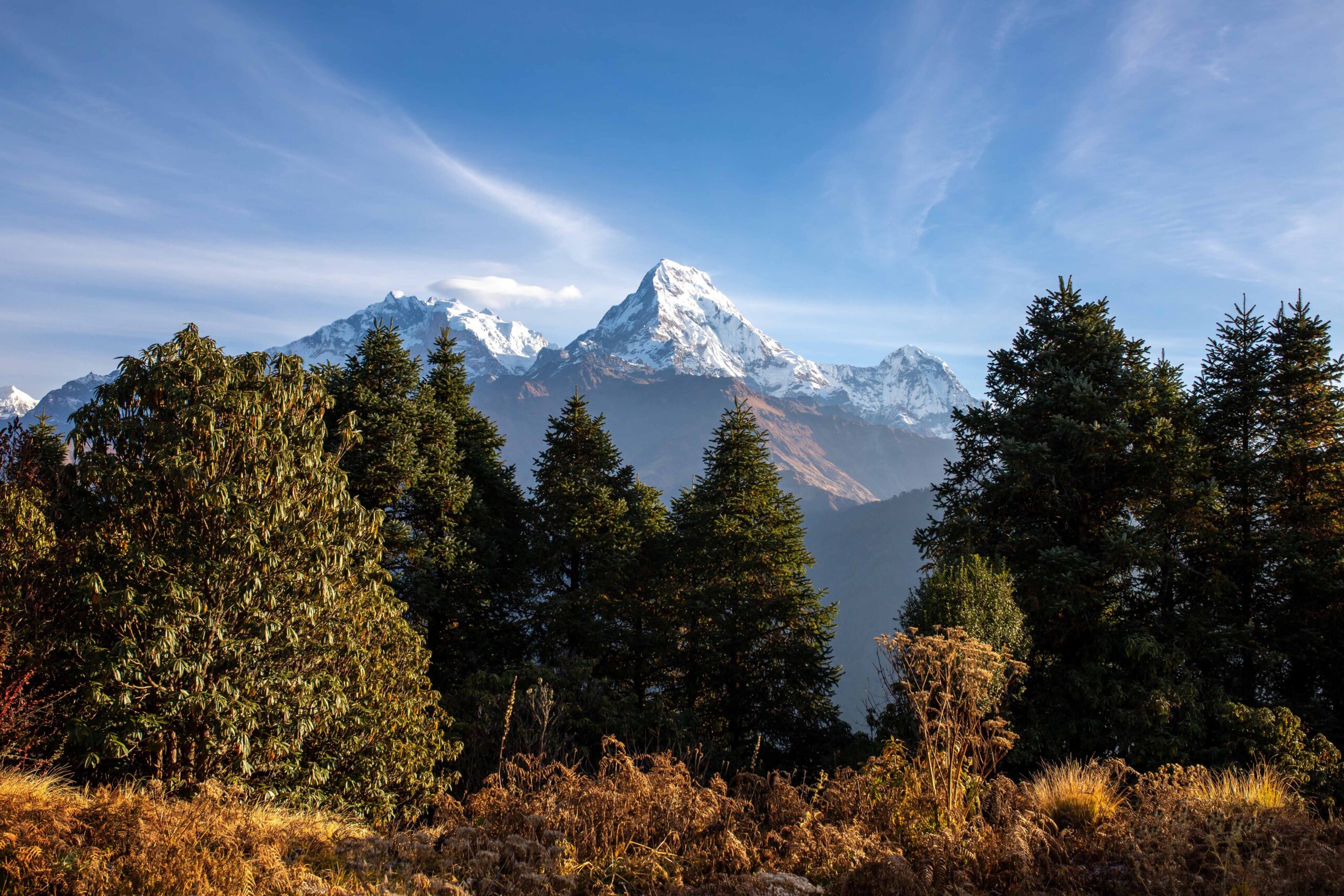
Annapurna Circuit: The Complete Guide to the Legendary Trek
The Annapurna Circuit is considered by many the finest long-distance trek on the planet — and that is no exaggeration. On a single route you pass through subtropical villages with rice paddies, into rhododendron forests, across alpine meadows and finally into a lunar high-altitude desert behind the Himalayas, capped by the legendary Thorong La pass at 5,416 metres. It is one of the great experiences a traveller from Greece can have in Nepal, and in this guide you will find everything you need to plan it properly: a day-by-day itinerary, permits, acclimatization, what drives the cost and the ideal season.
If you want the big-picture view of every Himalayan route first, start with our complete guide to trekking in Nepal and then come back here for the deep dive into the Circuit.
Why the Annapurna Circuit stands out
The Circuit's magic lies in its astonishing diversity of landscapes. You begin at around 760 metres, amid lush valleys of rice terraces and waterfalls, and gradually climb into alpine terrain and then the trans-Himalayan desert of Manang and Mustang — a rain-shadow region whose views recall Tibet. You cross the Kali Gandaki gorge, the deepest gorge in the world, flanked by the giants Annapurna (8,091m) and Dhaulagiri (8,167m).
| Detail | Annapurna Circuit |
|---|---|
| Duration | 12–18 days (typically 14–16) |
| Maximum altitude | Thorong La 5,416m |
| Distance | ~160–230 km (depending on road sections) |
| Difficulty | Strenuous — no technical climbing |
| Start / End | Besisahar / Muktinath–Jomsom (→ Pokhara) |
| Direction | Counter-clockwise (for proper acclimatization) |
| Lodging | Teahouses along the whole route |
| Best season | Oct–Nov & Mar–May |
| Permits | ACAP (+ TIMS) |
How many days? The roads that "shortened" the Circuit
The Annapurna Circuit used to be an 18–21 day adventure. In recent years, however, the construction of dirt roads has dramatically changed the picture: jeeps now reach Manang on the eastern side and Muktinath/Jomsom on the western side. This means two things:
- You can cut time by taking a jeep over the low, now vehicle-heavy sections (e.g. Besisahar → Chame or Dharapani, and Muktinath → Jomsom → Tatopani), focusing on the high, prettier, road-free stretches. This makes the trek feasible in as few as 10–12 days.
- The NATT alternative trails (New Annapurna Trekking Trails, with red-and-white waymarks) keep you on authentic paths away from jeep dust — worth every extra hour.
The question is no longer "how many days can I handle?" but "where do I want to walk and where will I take a jeep?". Most people choose 14–16 days with one or two jeep sections, leaving time for proper acclimatization before the pass.
Detailed itinerary (classic 14 days)
A realistic, well-tested plan starting with a jeep to Chame and finishing in Pokhara via Poon Hill:
| Day | Route | Altitude | Hours |
|---|---|---|---|
| 1 | Kathmandu → Besisahar → Chame (jeep) | 2,670m | 8–9 |
| 2 | Chame → Upper Pisang | 3,300m | 5–6 |
| 3 | Upper Pisang → Manang (via Ghyaru/Ngawal) | 3,540m | 6–7 |
| 4 | Manang — acclimatization day (Ice Lake or Gangapurna) | 3,540m | 3–5 |
| 5 | Manang → Yak Kharka | 4,050m | 3–4 |
| 6 | Yak Kharka → Thorong Phedi / High Camp | 4,540–4,880m | 3–4 |
| 7 | Thorong La pass → Muktinath | 5,416m → 3,760m | 7–9 |
| 8 | Muktinath → Kagbeni → Jomsom | 2,720m | 4–5 |
| 9 | Jomsom → Tatopani (jeep, hot springs) | 1,190m | 4–5 |
| 10 | Tatopani → Ghorepani | 2,870m | 6–7 |
| 11 | Poon Hill (sunrise) → Nayapul → Pokhara | 3,210m → 820m | 6–7 |
| 12 | Pokhara → Kathmandu | — | flight/bus |
Add 3–4 days if you take the Tilicho Lake detour (see below) and 1–2 buffer days for bad weather — the Himalayas don't forgive a rushed schedule. Your finish line is Pokhara, ideal for a day or two of rest beside Phewa Lake.
Thorong La: the pass at 5,416 metres
The highlight and the biggest challenge of the Circuit. The Thorong La pass (5,416m) is one of the highest trekking passes in the world. It is always crossed from the eastern side (Thorong Phedi or High Camp) toward the west (Muktinath), which is exactly why the whole Circuit is walked counter-clockwise: you climb gradually over several days so your body can adapt.
Pass day starts very early — usually 4:00–5:00 in the morning — to clear the top before the fierce, dangerous midday winds pick up. It is a long day of 7–9 hours with roughly 1,000m of ascent and 1,600m of descent. The historic 2014 blizzard, which cost dozens of lives on the pass, is a permanent reminder: respect the weather, never cross in doubtful conditions, and choose the right season.
Acclimatization & altitude sickness
The key to success (and safety) is not fitness but proper acclimatization. Above 3,000m the basic rule is: don't raise your sleeping altitude by more than 300–500m per day, and build in at least one acclimatization day in Manang (3,540m), where the uphill walk to Ice Lake (~4,600m) puts the "climb high, sleep low" principle into practice.
- Altitude sickness (AMS) symptoms: headache, nausea, dizziness, insomnia, fatigue. They usually appear above 2,500m.
- The golden rule: if symptoms worsen, descend. Altitude is non-negotiable.
- Diamox (acetazolamide): 125mg twice a day, starting 1–2 days before the big altitudes, helps with prevention — always on a doctor's advice.
- Water & pace: 3–4 litres of water a day and a slow, steady step ("bistari, bistari" the Nepalis say — slowly, slowly).
Because Thorong La is so high, altitude sickness is the number-one reason people fail — not lack of stamina. Don't rush.
Side trip: Tilicho Lake (4,919m)
If you have 3–4 extra days, Tilicho Lake is the jewel of the Circuit. At 4,919 metres it is one of the highest lakes in the world, its otherworldly turquoise water lying beneath glaciers. The detour starts from Manang: Manang → Tilicho Base Camp → Tilicho Lake and back. The trail to Base Camp crosses dangerous, unstable slopes prone to rockfall — walk early in the morning and with care.
Beyond the spectacle, the detour also serves as excellent acclimatization for Thorong La. Many experienced trekkers consider it a must.
Permits: ACAP & TIMS
The Annapurna Circuit crosses the protected Annapurna Conservation Area, so you need:
- ACAP (Annapurna Conservation Area Permit): ~NPR 3,000 (~€22) for foreigners. The main, mandatory permit.
- TIMS card: ~NPR 2,000 (~€14). Strict enforcement in the Annapurna region has relaxed in recent years, but it can be requested — carry it with you.
Both are issued easily at the Nepal Tourism Board office in Kathmandu or Pokhara (bring two passport photos and your passport). Note: since 2023 a rule requiring a licensed guide applies in many parts of Nepal; the situation for Annapurna keeps changing, so confirm the latest version before you go or hand it to an organised agency. For a full breakdown of all Nepal trekking permits (ACAP, TIMS, Sagarmatha, restricted areas), see our dedicated guide.
What drives the cost
The Annapurna Circuit is one of the most affordable big treks in the world, thanks to the teahouse system — but it does not come with a single price. What shapes it is the season, the size of the group, the length (12, 14 or 18 days, with or without Tilicho Lake), whether you want a guide and a porter, how many road sections you cover by jeep, and the comfort level you ask for in the lodges.
The only items known in advance are the official fees: the ACAP permit (~€22) and the TIMS card (~€14) per person.
Note that food prices climb as you climb: a dal bhat costing €2–3 lower down can reach €7–8 at Thorong Phedi, since everything is carried up by mule. Budget for cash (Nepali rupees) for the whole route — ATMs effectively stop after Chame.
Tell us how many days you can give it, whether you want Tilicho Lake as well, and how many of you there will be. Ask us for a quote.
Best season for the Annapurna Circuit
Season matters, because Thorong La can "close" under snow. For the full picture see our guide to the best time to visit Nepal, but in short:
- Autumn (late Sep–Nov): the peak season. Clear skies, stable weather, perfect visibility — but also the most people on the trail.
- Spring (Mar–May): blooming rhododendrons, warmer days, a little haze on the horizon. An excellent second choice.
- Winter (Dec–Feb): the pass is often blocked by snow and nights are bitterly cold. For experienced trekkers only, with a flexible schedule.
- Monsoon (Jun–Aug): rain, leeches and cloud at lower altitudes — but the Manang/Mustang side sits in the rain shadow and stays passable.
See also how Nepal's climate works by region, because the Circuit passes through three completely different climate zones in a single route.
Difficulty & preparation
The Circuit requires no technical climbing — it is a "teahouse trek" where you walk and sleep in lodges. Its difficulty lies in the altitude and the duration: many consecutive days of 5–8 hours' walking and the big pass. It is harder than Annapurna Base Camp, which reaches "only" 4,130m.
Prepare with 6–8 weeks of cardio training (uphill walking, stairs, running) and get used to your pack weight. Essentials: a layered clothing system, well broken-in boots, a warm sleeping bag (-10°C), gloves/beanie, and travel insurance that explicitly covers trekking above 4,000m and helicopter evacuation — non-negotiable for Thorong La. See our full Nepal packing list for the complete gear breakdown.
Getting there from Greece
There is no direct Athens–Kathmandu flight. You'll make one stop, usually via Istanbul (Turkish), Doha (Qatar) or Abu Dhabi/Dubai, with a total travel time of ~12–18 hours and a return ticket around €430–800 depending on season. For the overall planning (visa, flights, budget) see our Nepal travel guide.
If you'd rather not set up the logistics yourself, you can join an organised group trip or, for a premium, private version of the Circuit with experienced guides and hand-picked lodges, look at Elysian Himalaya — our premium travel partner in the Himalayas. Whether you do it independently or organised, the Annapurna Circuit is a journey of a lifetime.
Gallery
Frequently asked questions
- Typically 14–16 days, but with a jeep over the lower sections it can be done in 10–12. Add 3–4 days for the Tilicho Lake detour and 1–2 buffer days.
- Thorong La sits at 5,416 metres — one of the highest trekking passes in the world. The crossing starts before dawn to avoid the strong midday winds.
- The main one is the ACAP (~€22). A TIMS card (~€14) may be requested, though enforcement has relaxed. Both are issued in Kathmandu or Pokhara.
- There is no single price. The cost of the trek depends on the season, the size of the group, the length, whether you want a guide and a porter, and the comfort level of the lodges. The only fixed items are the official fees (ACAP ~€22, TIMS ~€14) and, separately, the flight from Greece (~€430–800). Tell us what you have in mind and we will send you a quote through our contact page.
- Autumn (late September–November) for clear skies and stable weather, and spring (March–May) for the rhododendrons. In winter the pass often closes under snow.
- It needs no technical climbing, but it is demanding because of the altitude and length. With good fitness, proper acclimatization and a slow pace, it is achievable for determined first-time long-distance trekkers.
Keep reading
Related articles
 Activities
Trekking in Nepal: The Complete Hiking Guide
The definitive guide to trekking in Nepal: teahouse trekking, the main regions, a comparison of the top treks, permits, seasons and how to choose your route.
 Trekking
Annapurna: The Complete Trekking Guide to Nepal's Most Popular Region
The Annapurna massif, the top routes (ABC, Circuit, Poon Hill, Mardi Himal, Tilicho), the ACAP permit, seasons, sample itineraries and how to choose.
TrekkingAnnapurna Base Camp Trek (ABC): The Complete Guide
The 'amphitheatre of the gods' at 4,130m: a day-by-day itinerary, difficulty, ACAP permits, seasons and how to combine it with Poon Hill.