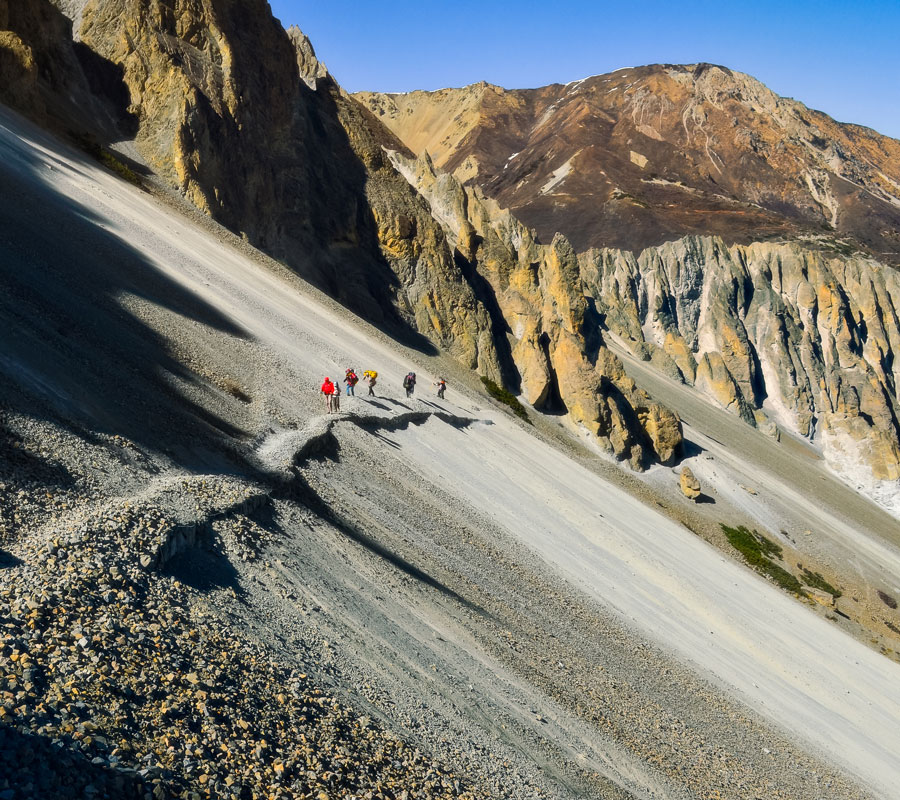
The Manaslu Circuit is perhaps the best-kept secret in the Himalayas: a route that loops around Manaslu (8,163m), the 8th highest mountain on the planet, through remote villages of the Gorkha region with a strong Tibetan culture and views that owe nothing to Everest or Annapurna. The name comes from the Sanskrit word "manasa" (spirit, soul) — which is why it is called "the Mountain of the Spirit."
It is a restricted-area trek, and that changes everything: you cannot do it on your own. You are required to have a licensed guide, a minimum of two trekkers and three separate permits. But that very "lock" is what keeps it authentic: fewer people on the trail, simpler lodges, more of the real Nepal. If you have already done the classic Annapurna trek and are after something wilder, Manaslu is the logical next target.
Quick overview: the essentials at a glance
| Detail | Value |
|---|---|
| Duration | 14–18 days total (12–14 walking days) |
| Maximum altitude | Larke La pass — 5,106m |
| Difficulty | Strenuous — good fitness required |
| Distance | ~160–180 km |
| Permits | RAP + MCAP + ACAP (all three mandatory) |
| Guide | Mandatory + minimum 2 trekkers (no solo) |
| Best season | Late Sep–Nov & Mar–May |
| Accommodation | Tea houses / lodges (more basic than Annapurna) |
Why the Manaslu Circuit?
Manaslu only opened to foreign trekkers in 1991 and to this day receives a fraction of the visitors that Annapurna or Everest see. What you gain:
- Solitude and quiet. You will cross paths with a handful of groups a day, not hundreds. Unlike the Annapurna Circuit, the jeep road has not yet invaded the whole route here.
- Authentic Tibetan culture. The upper villages (Lho, Sama Gaon, Samdo) in the Nubri valley are ethnically Tibetan, with Buddhist monasteries (gompas), prayer flags and mani walls.
- A full sweep of landscapes. You start in subtropical gorges with rice paddies and waterfalls at ~700m and end in alpine, glacial terrain beneath the mass of Manaslu.
- A "real" pass. Larke La at 5,106m is one of Nepal's finest high passes, with a panorama towards Himlung, Cheo Himal and Annapurna II.
Difficulty: how hard is it really?
It is not a technical mountain — you do not need ropes or crampons in normal conditions. It is, however, physically demanding: 12–14 consecutive walking days, 4–7 hours of climbing daily, and one very long day for the pass. Lodges and food are more basic than on Annapurna.
What you need to enjoy it rather than endure it:
- A decent aerobic base — if you can walk 5–6 hours in the mountains with a pack, you are fine.
- Proper acclimatization: the schedule builds in rest days at Sama Gaon and possibly Samdo. Do not skip them.
- Insurance that covers helicopter evacuation above 5,000m — non-negotiable.
For symptoms, the "climb high, sleep low" rule and managing altitude sickness, see the detailed general trekking guide to Nepal.
Detailed itinerary (classic 14 days)
The most common schedule starts and ends with an overland drive from Kathmandu. A typical plan:
| Day | Route | Altitude |
|---|---|---|
| 1 | Kathmandu → Machha Khola (jeep 8–9 hrs) | ~870m |
| 2 | Machha Khola → Jagat | 1,410m |
| 3 | Jagat → Deng | 1,804m |
| 4 | Deng → Namrung | 2,630m |
| 5 | Namrung → Lho (first Manaslu views) | 3,180m |
| 6 | Lho → Sama Gaon | 3,530m |
| 7 | Acclimatization day (Manaslu Base Camp or Birendra Lake) | 3,530m |
| 8 | Sama Gaon → Samdo | 3,860m |
| 9 | Samdo → Dharamsala (Larke Phedi) | 4,460m |
| 10 | Dharamsala → Larke La (5,106m) → Bimthang | 3,720m |
| 11 | Bimthang → Tilije | 2,300m |
| 12 | Tilije → Dharapani → Besisahar (jeep) | 760m |
| 13 | Besisahar → Kathmandu (or on to Pokhara) | 1,400m |
| 14 | Buffer day (weather / rest) | — |
The big day: Larke La pass (5,106m)
This is the climax of the trek. You leave Dharamsala around 4 a.m. by headlamp, climb steadily through the frozen dark and reach the pass after 4–5 hours. Then comes a long, knee-punishing descent to Bimthang. Eight to ten hours in total. Bring warm layers, gloves, sunglasses and sunscreen — and start early to beat the afternoon winds.
Accommodation, food & life on the trail
The tea houses on Manaslu are simpler than those on Annapurna, but they have improved a great deal over the past decade. In the lower villages you get private twin rooms; as you climb towards Samdo and Dharamsala, the lodges become basic, with shared toilets. A hot shower (often a bucket) and phone charging cost extra, especially high up.
The food? Everywhere you will find dal bhat — rice, lentils, vegetables and pickle — the trekker's energy "fuel," usually with a free second helping. There are also noodles, potatoes, momo and thukpa. The higher you go, the pricier and more limited the menu. Drink only bottled or purified water.
Culturally, from Namrung upwards you enter a purely Tibetan world: women in traditional chuba, elders spinning prayer wheels, the great monastery at Lho and the magical quiet of Sama Gaon beneath the mass of Manaslu. Be respectful: always pass mani walls and stupas on their left and ask permission before photographing people.
Permits: RAP + MCAP + ACAP
Because Manaslu is a restricted area, you need three permits — and you can only obtain them through a registered agency, never on your own:
| Permit | What it is | Cost (2026) |
|---|---|---|
| RAP (Restricted Area Permit) | The special entry permit for the region | Sep–Nov: $100 / 7 days, +$15/day after. Dec–Aug: $75 / 7 days, +$10/day |
| MCAP (Manaslu Conservation Area) | Manaslu protected-area permit | ~NPR 3,000 (~€22) |
| ACAP (Annapurna Conservation Area) | Covers the final stretch that enters the Annapurna region | ~NPR 3,000 (~€22) |
Two important rules: (1) the RAP is issued for a minimum of two trekkers — if you travel alone, the agency places you in a group or "rents" a second person on paper; (2) a licensed guide is mandatory. Good news: with the RAP you do not need a separate TIMS card. If you are also considering the side trip into the Tsum Valley, that requires its own RAP. For the full picture of every permit, see the Nepal trekking permits guide.
What drives the cost
Manaslu is pricier than Annapurna, mainly because of the permits and the mandatory guide — but it has no single price. The cost is shaped by the season (the RAP costs more from September to November), the size of the group (the guide and the jeeps are shared), the length (14 days for the classic loop, more with the Tsum Valley), whether you want a porter, and the comfort level of the lodges.
The only items known in advance are the official fees: RAP + MCAP + ACAP, roughly €150–180 per person. Budget separately for the flight from Greece (~€500–800), a couple of days in Kathmandu, gear and insurance. For the overall plan and the Athens–Kathmandu flights, see the complete Nepal travel guide.
Tell us how many of you there will be and which month you have in mind — on Manaslu the group shares the mandatory guide, while the RAP changes price between seasons. Ask us for a quote.
Best time for the Manaslu Circuit
| Season | Months | What to expect |
|---|---|---|
| Autumn (peak) | Late Sep – Nov | Clear skies, stable weather, safe pass crossing. The ideal window. |
| Spring | Mar – May | Rhododendrons in bloom, warm days, a little more haze in the views. |
| Monsoon | Jun – Aug | Rain, mud, leeches, landslides — avoid. |
| Winter | Dec – Feb | Very cold; the Larke La is often shut by snow. |
More on weather by month and activity in the best time to visit Nepal guide.
Manaslu Circuit vs Annapurna Circuit
The most common question. Both loop around a mountain massif over one high pass — but the experience is very different:
| Manaslu Circuit | Annapurna Circuit | |
|---|---|---|
| High pass | Larke La — 5,106m | Thorong La — 5,416m |
| Duration | 14–18 days | 12–18 days |
| Permits | RAP + MCAP + ACAP | ACAP only |
| Guide | Mandatory + 2 people | Not mandatory (historically) |
| Crowds | Few — remote | Many — busy |
| Road / jeeps | Minimal | Reaches much of the route |
| Accommodation | More basic | More developed, hot showers |
| Ideal for | Experienced trekkers after authenticity | A first big circuit, flexibility |
In short: if it is your first big circuit and you want flexibility, start with Annapurna. If you already have trekking experience and are chasing the wilderness, Manaslu wins.
Altitude sickness, safety & practicalities
You climb above 5,000m, so acclimatization is critical. Stick to "climb high, sleep low," do not raise your sleeping altitude by more than ~400–500m/day above 3,000m, drink plenty of water and respect the rest days. Your guide monitors your condition — listen to them. Travel insurance with helicopter cover is essential, because in a restricted area, evacuation is only possible by air.
There is no direct flight from Greece: you fly Athens–Kathmandu with one stop (Istanbul, Doha, Abu Dhabi or Dubai), ~12–18 hours. In Thamel, Kathmandu, you can buy (and rent) all the gear you need: boots, a −10°C sleeping bag, poles, layered clothing. In the villages you pay in cash (Nepali rupees) — there is no ATM above Machha Khola. For a full layered gear list for 5,000m, see what to pack for Nepal.
Organised & premium: Manaslu without the stress
Because the trek absolutely requires an agency, permits and a guide, the best option for a traveller from Greece is a properly organised group. See the gateway points around Pokhara and the general trekking guide to understand how an expedition comes together.
For those who want Manaslu in a premium version — a private guide, carefully chosen lodges, proper unhurried acclimatization and full on-the-ground support — Elysian Himalaya designs bespoke expeditions, with Dimitris and Greek-speaking support through the planning. It is the most relaxed way to experience one of the wildest routes in the Himalayas.
The Manaslu Circuit is neither the easiest nor the most famous trek in Nepal — and that is exactly why it is worth it. It is for anyone who wants the Himalayas as they were before they became an industry: quiet, authentic and utterly overwhelming.
Gallery
Frequently asked questions
- Yes, it is mandatory. Manaslu is a restricted area: you need a licensed guide through a registered agency and a minimum of two trekkers. Solo trekking is not permitted.
- The trek itself is 12–14 walking days. Adding the drives to and from Kathmandu plus one buffer day for weather, plan for 14–18 days in total.
- Larke La tops out at 5,106m and is the highest point of the route. Crossing day is 8–10 hours of walking with a pre-dawn start — demanding but non-technical.
- You need three: RAP (~$100 for the first 7 days in high season, +$15/day after), MCAP (~€22) and ACAP (~€22). Around €150–180 per person, not counting the guide.
- Autumn (late September–November) and spring (March–May). Avoid the monsoon (Jun–Aug) and deep winter, when the Larke La pass can be snowed shut.
- The Annapurna Circuit is easier to organise and more developed. Manaslu is more remote, more authentic and far quieter — but it requires a guide, permits and better fitness.
Keep reading
Related articles
 Activities
Trekking in Nepal: The Complete Hiking Guide
The definitive guide to trekking in Nepal: teahouse trekking, the main regions, a comparison of the top treks, permits, seasons and how to choose your route.
 Trekking
Annapurna: The Complete Trekking Guide to Nepal's Most Popular Region
The Annapurna massif, the top routes (ABC, Circuit, Poon Hill, Mardi Himal, Tilicho), the ACAP permit, seasons, sample itineraries and how to choose.
 Trekking
Annapurna Base Camp Trek (ABC): The Complete Guide
The 'amphitheatre of the gods' at 4,130m: a day-by-day itinerary, difficulty, ACAP permits, seasons and how to combine it with Poon Hill.