

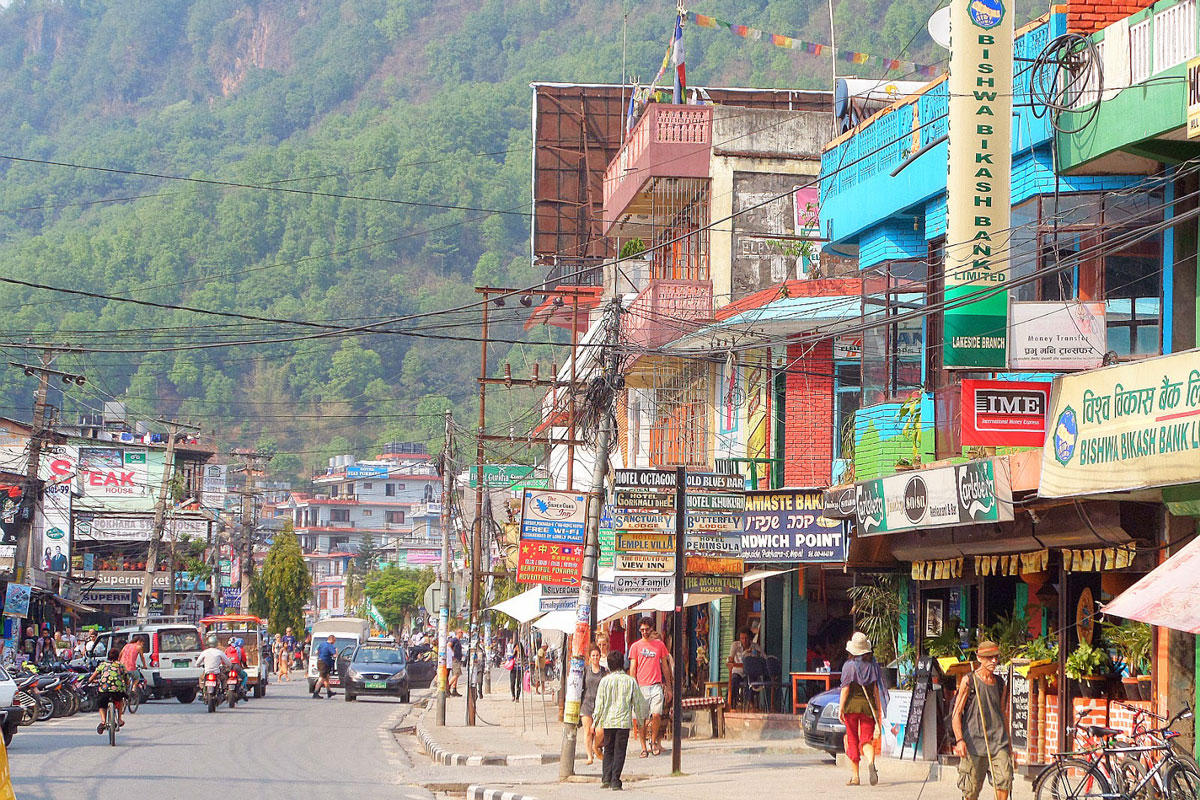
You land in Kathmandu after a 14-hour flight from Athens, turn on your phone — and you want to text an "I've arrived" to your family, open the map, confirm the hotel. The question "how do I stay online in Nepal?" is one of the first practical ones you solve, and the good news is that the country, despite its mountains, has remarkably good and cheap connectivity. A local SIM with plenty of data costs less than a coffee back in Greece.
This guide explains, with real 2026 figures (in euros and in Nepalese rupees, NPR), which provider to choose, where and how to buy a SIM, what data packs cost, when an eSIM makes sense, how teahouse WiFi works, and — most crucial for anyone trekking — what signal you'll get high in the mountains. It's part of our practical Nepal travel guide and complements our guide to trekking in the Himalayas.
The two providers: Ncell vs NTC (Namaste)
Two networks dominate Nepal, and the choice between them depends almost entirely on where you're going: are you staying in the cities or heading up the mountains?
Ncell — the king of the city
Ncell is a private provider and the most popular network among foreigners. It has the fastest 4G (and limited 5G) in Kathmandu, Pokhara and Chitwan, the best tourist data packs, and the easiest process at the airport. If your trip is mainly cities, temples, safari and lakeside — Ncell is the obvious choice. Its weakness shows only once you start climbing: above 3,000 m its coverage becomes patchy.
NTC / Namaste — the mountain provider
Nepal Telecom (NTC), marketed as Namaste, is the state-owned provider. In the cities it's a little slower than Ncell, but it holds one undisputed throne: mountain coverage. Thanks to its infrastructure in remote areas, NTC picks up 4G in places where Ncell simply doesn't exist — it reaches Annapurna Base Camp (4,130 m) and gives signal above Namche on the Everest Base Camp route. If you plan to trek, NTC is the provider you want in your pocket.
Ncell or NTC? The quick decision guide
- Cities only (Kathmandu, Pokhara, Chitwan, Lumbini): Ncell. Faster, cheaper packs, easy to buy.
- Trekking (EBC, ABC, Circuit, Langtang): NTC / Namaste. The only one with reliable coverage at altitude.
- Both, and I want certainty: get one SIM from each provider (the cost is pennies) or one NTC + one eSIM for the city. Two cards keep you connected almost everywhere.
In practice, many experienced travellers carry two SIMs: NTC for the mountains, Ncell (or an eSIM) for city speed. At card prices of €1–4, it's not overkill — it's insurance.
Where & how to buy a SIM
There are two main ways: at the airport the moment you land, or at a shop in the city.
- At the airport (Tribhuvan, Kathmandu): in the arrivals hall, after passport control, there are Ncell and NTC counters. It's the most convenient way — you walk out already connected. Prices are slightly higher than in the city, but the difference is small.
- In the city: countless shops in Thamel (Kathmandu's tourist heart) and around Lakeside in Pokhara. Often a little cheaper and with help setting up. Prefer an official store or a reputable shop, not a street stall.
- Documents: your passport + one passport photo. It's good to carry 1–2 photos anyway (you'll also need them for permits). Some points now take the photo on the spot.
- Activation: because of mandatory identity verification (KYC), the card may activate within minutes or take a couple of hours. Don't panic if it's slow — it's normal.
Prices: data packs 2026
The SIM itself is almost free; what you pay for is the data pack. The figures below are indicative for 2026 (rate ~NPR 145 / €) and change by promotion, but they give you a clear picture of just how cheap it is.
| Provider | Pack | Data | Duration | Price (NPR) | ~€ |
|---|---|---|---|---|---|
| Ncell | Tourist SIM (card) | small starter data | — | 100–200 | ~€1 |
| Ncell | Data pack S | ~12 GB | 7 days | 600 | ~€4 |
| Ncell | Data pack M | ~25 GB | 28 days | 1,000 | ~€7 |
| Ncell | Data pack L | ~50 GB | 28 days | 2,000 | ~€14 |
| NTC | Tourist SIM (data + mins) | ~10 GB + calls | 30 days | 1,000 | ~€7 |
| NTC | Data pack M | ~14 GB | 28 days | 700 | ~€5 |
| NTC | Data pack L | ~40 GB | 30 days | 1,600 | ~€11 |
In other words: for a two-week trip, €7–15 total in data comfortably covers you. Packs load easily from the provider's app or via USSD codes (you dial a number and pick a pack), and there are "recharge/top-up" points everywhere to refill credit.
eSIM: the no-queue option
If your phone supports eSIM (every iPhone from the XS on, most modern Androids), there's also the "zero-effort" route: you buy a digital pack before leaving Greece, activate it with a QR code, and the moment you land you're already online — no counters, no photos, no waiting for activation.
| eSIM provider | Indicative pack | Price | Network |
|---|---|---|---|
| Airalo | 3 GB / 30 days | ~€8 | Ncell |
| Airalo | 10 GB / 30 days | ~€17 | Ncell |
| Holafly | unlimited / per day | ~€6/day | Ncell |
| Nomad / Saily | 5–10 GB | ~€10–18 | Ncell/NTC |
The crucial fine print: almost all international eSIMs run on the Ncell network. That means they're excellent for cities and your first days, but they inherit Ncell's weakness at altitude. The practical combination that works perfectly: an eSIM for arrival and cities + a local NTC for the trekking. That way you have instant connection from the airport and reliable signal on the mountain, for a total cost under €25.
WiFi in hotels and teahouses
In the cities WiFi is everywhere and usually free: hotels, restaurants and cafés in Thamel and around Pokhara's Lakeside offer decent speeds. At mid-range and up accommodation you'll have no trouble with a video call or uploading photos.
In teahouses while trekking the picture changes. Most lodges on the trails offer WiFi, but:
- It's usually for a fee, via cards like Everest Link or Airlink: NPR 500–700 (~€3–5) for a data or time allowance.
- The higher you climb, the slower and less stable it gets. In the highest villages even a simple message may struggle to load.
- In the lower villages it's often free with your meal or overnight stay.
The practical rule: don't rely solely on teahouse WiFi. Combine it with an NTC SIM and you'll have the maximum possible coverage.
Coverage on the treks: Everest & Annapurna
This is where your choice is decided. The table below shows, realistically, what to expect by region. Remember: signal in the mountains is always a "bonus", not a given — let your family know there will be days of silence.
| Region | Ncell | NTC (Namaste) | Teahouse WiFi |
|---|---|---|---|
| Kathmandu / Pokhara (cities) | Excellent 4G/5G | Good 4G | Everywhere, free |
| Lower trek villages (<3,000 m) | Good | Good | Often, cheap/free |
| Namche Bazaar (3,440 m) | Patchy | 4G | Everest Link (paid) |
| Upper EBC → Gorak Shep (5,140 m) | Rare/none | Intermittent | Everest Link, slow |
| Annapurna Base Camp (4,130 m) | Weak | 4G (reaches ABC) | Paid, unstable |
| Remote (Manaslu, Dolpo, Mustang) | Minimal | Spots only | Rare |
Bottom line: for Everest Base Camp and Annapurna Base Camp, NTC is clearly superior — it reaches higher with 4G. For the truly remote treks (Manaslu, Upper Dolpo), assume you'll be off-network for days and download offline maps (maps.me, Gaia) before you set off. A good power bank matters as much as signal — see what to bring in the packing list, since electricity in teahouses is charged and not always available.
VPN in Nepal: do you need one?
It's not mandatory, but a good VPN is worth it for three reasons:
- Security: on public WiFi (airport, cafés, teahouses) a VPN encrypts your connection and protects passwords and online banking.
- Access: from time to time Nepal temporarily restricts certain apps or services; a VPN ensures steady access. It also gives you a "Greek" IP for platforms you use (streaming, banking apps).
- Peace of mind: VPNs are legal for travellers in Nepal.
Important: download and set up the VPN before you leave Greece. If you leave the install for on the ground and its website happens to be blocked, you're in a vicious circle. Reliable options: NordVPN, Proton VPN, Surfshark. A subscription — or even a reliable free VPN (e.g. Proton's free tier) — covers the average traveller.
Practical tips for travellers from Greece
- Unlock your phone before you leave so it accepts a foreign SIM. Most Greek contracts give unlocked devices, but confirm it.
- Keep Greek roaming on for the first hour (bank SMS, codes) — then switch to the local SIM. Careful: roaming outside the EU is expensive, so turn data off.
- Two SIMs = peace of mind: NTC for the mountain, Ncell/eSIM for the city. Total cost under €20–25 for the whole trip.
- Activate WhatsApp/Viber before you change SIM, so you don't lose number verification.
- Offline maps & VPN downloaded from Greece — the two things you'll want that don't download easily on the ground.
- Power bank & adapter: electricity in teahouses is charged and cuts out; see the packing list.
Connectivity in Nepal is, in the end, one of the easier parts of the trip: cheap, fast in the cities and remarkably good in the mountains if you pick the right provider. But if you'd rather not deal with counters, activations and WiFi cards at all — on an organised trip all these logistics are handled by the team. For a high-end trip in the Himalayas, where communication, safety and every practical detail is planned in advance, see the premium partnership Elysian Himalaya. You simply enjoy the view; we take care of the rest.
Gallery
Frequently asked questions
- For cities and fast internet, Ncell. For trekking in the mountains, NTC (Namaste) — it has the best high-altitude coverage, reaching 4G at Annapurna Base Camp and above Namche. If you'll do both, take NTC or, ideally, one SIM from each provider.
- Partly. NTC has 4G at many points along the route and Namche is covered. Higher up (Gorak Shep, EBC) the signal is unstable; there, the teahouses' WiFi via an Everest Link card is the most reliable option.
- At the Ncell/NTC counters in the arrivals hall of Kathmandu airport, or in shops in Thamel and around Pokhara's Lakeside. You need your passport and one passport photo. Activation takes anywhere from a few minutes to a couple of hours.
- Yes, if you want to be online the moment you land, with no queues. It costs €5–20 and you activate it from home. The downside: eSIMs usually run on the Ncell network, so they're less reliable high in the mountains. For trekking, a local NTC.
- Yes, in most, but for a fee — usually Everest Link or Airlink cards at NPR 500–700. The higher you climb, the slower and less stable it gets. In the lower villages it's often free with your meal or overnight stay.
- It's not mandatory, but recommended. It protects your data on public/teahouse WiFi, unlocks services that are occasionally restricted, and gives you access to Greek platforms. Download it before you leave — installs are harder to do on the ground.
Keep reading
Related articles
 Articles
The biggest help you can give Nepal is to visit
On 26 August 2026 a piece of mountain turned into water and took villages, bridges and more than a thousand lives with it. I have lived here for fifteen years. Here is what happened, what is open, how you can help today, and why your trip in October is the biggest help of all.
 Info
InfoWhat Is the Climate Like in Nepal?
Everything about Nepal's climate — four seasons, three climate zones, temperatures by region and when the sky is clear for the Himalayas.
 Info
InfoThe Best Time to Visit Nepal
When should you travel to Nepal? A decision guide by activity — trekking, safari, culture — with a table, crowds, prices and festivals.